


Table of Contents
- Why Testing Outdoor Gear Durability Matters
- Understanding Material Quality and Construction
- How to Identify High-Quality Outdoor Gear
- Common Outdoor Gear Failure Points
- Outdoor Gear Stress Testing Methods
- Long-Term Wear and Tear Assessment
- Quantitative Durability Metrics and Standards
- Testing Your Gear Before the Mission
- Frequently Asked Questions
Last Updated: September 21, 2026
Why Testing Outdoor Gear Durability Matters
Good gear fails. Not always, but often enough that you need to know what to look for before you trust your life to it. At Dragoon Unlimited, we've spent years designing and learning how to test outdoor gear durability in shelters and jackets that actually hold up in the field. The difference between gear that survives and gear that fails comes down to how well you understand what you're buying.

Testing outdoor gear durability isn't optional for serious users. When you're miles from civilization, a broken zipper or seam failure stops being an inconvenience and becomes a survival problem. The right inspection process catches those weaknesses before they matter.
This guide walks you through how to test outdoor gear durability like a professional. You'll learn to spot quality in materials, identify stress points before they fail, and run your own field tests that reveal what marketing claims hide.
Understanding Material Quality and Construction
Material choice determines how long gear lasts. The best outdoor gear uses fabrics engineered for specific conditions. Understanding what you're looking at separates smart purchases from expensive mistakes.
Denier, Tensile Strength, and Ripstop Fabric
Denier measures fabric weight and thickness. A higher denier number means thicker, more durable material. Ripstop fabric uses a crosshatch pattern of thicker threads to prevent tears from spreading. When you see 500D ripstop, that 500 tells you the thread weight. Thicker doesn't always mean better, a 1000D fabric might be overkill for a lightweight shelter, but essential for a pack that gets dragged across rocks.
Tensile strength measures how much force a fabric can withstand before tearing. This matters more than denier alone. Two fabrics with the same denier can have different tensile strengths depending on how they're woven. Check product specs when available. If a manufacturer won't share tensile strength data, that's worth noting.
Ripstop prevents small tears from becoming catastrophic failures. A tear in regular fabric spreads. A tear in ripstop stops at the reinforced grid. For field gear, ripstop is non-negotiable.
Seam Sealing and Stitch Density
Seams fail more often than fabric. Water finds every gap. Seam sealing is the tape or sealant applied to the inside of stitched seams to block water penetration. Without it, even waterproof fabric leaks where threads pierce the material.
Stitch density tells you how close together the stitches are. More stitches per inch means stronger seams. A quality tent has 8-12 stitches per inch. Count them if you're inspecting gear in person. Loose, widely-spaced stitches fail faster under stress.
Look for these signs of good seam construction:
- Seams are straight and even, not wavering
- Stitches are tight and consistent
- Sealing tape covers all seams, especially on the inside
- Thread color matches the fabric (shows attention to detail)
- No loose threads or fraying at seam edges
How to Identify High-Quality Outdoor Gear
Spotting quality before you buy saves money and prevents failures when it matters. Walk through these checks every time you evaluate new gear.
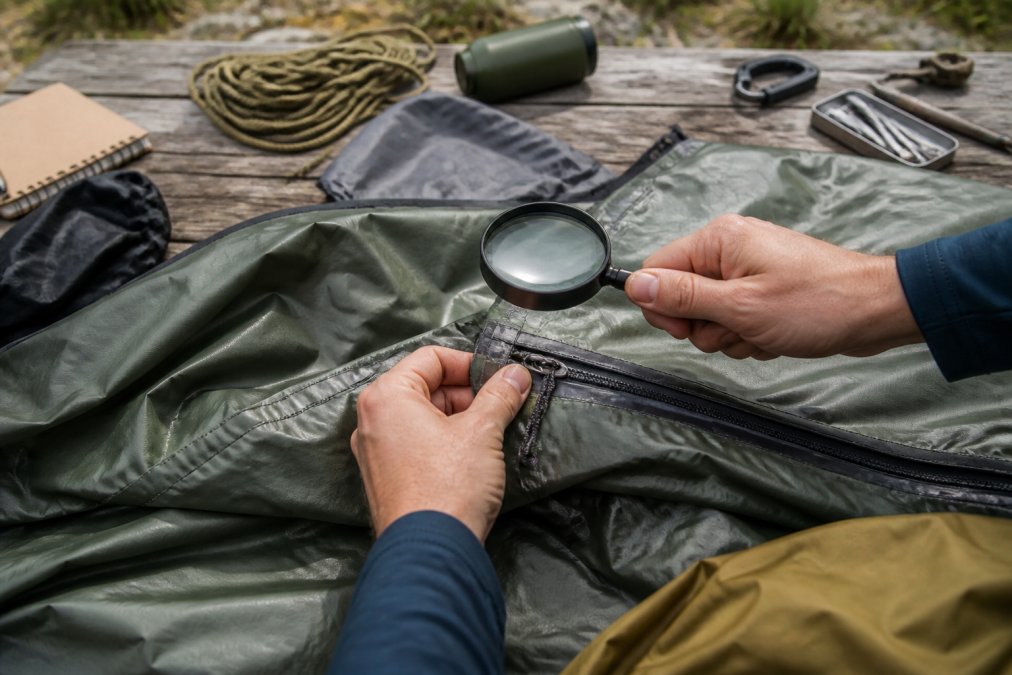
Evaluating Hardware Integrity and Zippers
Zippers are stress points. They fail constantly. A broken zipper on a tent or shelter isn't a minor inconvenience, it's a mission failure.
Check zippers by:
- Sliding them smoothly through their full range without resistance
- Looking for teeth that are evenly spaced and undamaged
- Confirming the slider moves freely without grinding
- Inspecting the fabric tab where the zipper attaches for reinforcement
Quality gear uses heavy-duty zippers rated for outdoor use. Cheap zippers jam, corrode, or separate under load.
Buckles, clips, and attachment points should be:
- Metal or reinforced plastic, never thin plastic
- Securely stitched or riveted, not glued
- Free of cracks or sharp edges
- Able to handle repeated use without loosening
Test buckles by pulling them hard. They shouldn't flex or creak. If they do, they'll fail in the field.
Checking DWR Coating and Waterproofing
DWR (durable water repellent) coating makes fabric shed water without blocking breathability. It's not waterproofing, it's a surface treatment that beads water and prevents saturation. Over time, DWR wears off.
Test DWR by pouring water on the fabric. It should bead up and roll off. If water soaks in and spreads, the DWR is gone or was never applied. This is a quick field test that takes 30 seconds.
Waterproofing is different from DWR. A waterproof layer (like a bathtub floor on a tent) blocks water completely. DWR keeps water from sticking to the fabric surface. Quality gear uses both: DWR on the outer layer and a waterproof backing underneath.
Check product descriptions for:
- Hydrostatic head rating (measures water pressure resistance)
- Seam sealing (already covered above)
- Material composition (synthetic fabrics hold DWR better than natural ones)
Common Outdoor Gear Failure Points
Gear fails at predictable locations. Knowing where to look saves you from buying equipment destined to fail.
Stress Points and Abrasion Zones
Stress concentrates at attachment points. Where a strap connects to a pack, where a tent pole slides into a sleeve, where a shelter ties to anchor points, these areas see repeated flexing and pressure.
Dragoon Unlimited Ridgeback One Person →
Inspect stress points for:
- Extra reinforcement (thicker fabric, additional stitching)
- Smooth edges that won't cut through material under load
- Proper distribution of force (a single stitch point will fail; multiple anchor points survive)
Abrasion zones are areas that rub against other materials. The bottom of a tent rubs the ground. Pack straps rub against your shoulders. Gear sitting in sand or dirt gets abraded constantly.
Quality gear protects these zones with:
- Thicker, more durable fabric in high-wear areas
- Reinforced patches at corners and contact points
- Smooth finishes that won't snag or tear
Zipper Failure and Seam Breakdown
Zippers fail from dirt, corrosion, and mechanical stress. Sand jams the slider. Salt water corrodes the teeth. Pulling too hard separates the track.
Seams break down from:
- Inadequate stitch density
- Poor thread quality
- Stress concentration (all the load on one seam instead of distributed)
- Water damage (if seams aren't sealed)
Test seams by pulling perpendicular to the stitch line. A quality seam resists hard pulling without separating. A weak seam starts to tear immediately.
Outdoor Gear Stress Testing Methods
Real testing reveals what inspection misses. Field conditions expose weaknesses that look fine in a store.
DIY Stress-Testing Protocols
You can run your own durability tests without expensive equipment. These protocols simulate real-world conditions:
Flexing test: Bend and flex the gear repeatedly. A tent pole sleeve, for example, gets bent thousands of times in normal use. Flex it 100 times by hand. Check for cracks, separation, or material degradation.
Abrasion test: Rub the fabric against rough surfaces (concrete, sandpaper, dirt) for 30 seconds. Quality gear shows minimal wear. Poor gear frays or tears.
Seam stress test: Pull on seams perpendicular to the stitch line with moderate force. Hold for 10 seconds.
Field Testing and Real-World Evaluation
Lab tests don't capture everything. Real conditions introduce variables that matter: temperature swings, moisture cycling, UV exposure, wind stress, and the unpredictable abuse of actual use.
Track performance by noting:
- How easily the gear deploys and sets up
- Whether seams, zippers, and hardware hold under real stress
- How well it sheds water and handles moisture
- Any areas that show wear after normal use
- How comfortable and functional it is during extended use
Long-Term Wear and Tear Assessment
Durability isn't about surviving one trip. It's about performing reliably over years of use.
Maintenance-Based Durability
How you maintain gear determines how long it lasts. Some materials require care to preserve function.
Quantitative Durability Metrics and Standards
Some durability measures use numbers. These metrics help compare gear objectively.
Testing Your Gear Before the Mission
Before you depend on gear for a real mission, test it completely. Don't learn about failures in the field.
Run a complete checkout:
- Set up and deploy the gear in your backyard
- Use it in mild conditions first (light rain, cool temperatures)
- Inspect it after each use for signs of wear or damage
- Address any issues immediately before they spread
- Graduate to more challenging conditions only after the gear proves reliable
Frequently Asked Questions
What are the most common failure points in outdoor gear?
Zippers, seams, and stress points where fabric bends repeatedly are the most vulnerable areas. Seam failure occurs when stitching separates under tension or water pressure. Zipper teeth can jam or break from dirt, sand, or misalignment. Abrasion zones, where gear rubs against your body, rocks, or branches, wear through faster than other areas. Testing these specific points first identifies whether gear will hold up in the field.
How can I stress-test my gear without destroying it?
Start with controlled, progressive tests. For tents, apply water with a hose at different angles and pressures to check seam sealing. For fabric, perform repeated flexing tests by folding and unfolding sections 100+ times. For zippers, cycle them open and close while introducing dirt or sand to simulate field conditions. For straps and hardware, apply gradual tension increases. Document any failures and their location. This reveals durability limits before the gear fails during an actual mission.
What should I look for when inspecting outdoor gear construction?
Examine stitch density, quality gear has tight, even stitching with no gaps. Check seam sealing by running your finger along seams; they should feel smooth and sealed. Inspect zippers for smooth operation and secure attachment. Look at fabric denier rating; higher denier (600D and above) resists abrasion better. Verify DWR coating by applying water; it should bead up rather than soak in. Test hardware like buckles and snaps for secure attachment and smooth operation. The Ridgeback Tent uses UV-resistant ripstop fabric with taped seams and a bathtub-style waterproof floor, exemplifying construction quality worth checking for.
How does field testing differ from laboratory durability testing?
Laboratory testing applies controlled, repeatable stress under specific conditions to measure failure points. Field testing exposes gear to unpredictable combinations of weather, terrain, and user behavior. A tent might pass lab waterproofing tests but fail in wind-driven rain because seams weren't sealed perfectly. Gear tested in the field reveals real-world vulnerabilities, mud, temperature swings, and physical abuse, that labs cannot fully replicate. The best durability assessment combines both approaches: lab data tells you the spec, field testing tells you if it works when it actually matters.


