


Table of Contents
- Why Testing Ripstop Fabric Durability Matters Before You Buy
- Test 1: The Tear Propagation Test for Ripstop Fabric Tear Resistance
- Test 2: Abrasion Resistance Evaluation for Ripstop Fabric
- Test 3: The Water Repellency and Ripstop Fabric Waterproof Test
- Test 4: Seam Strength Evaluation with the Fabric Seam Strength Test
- Test 5: Tensile Strength and Breaking Point Assessment
- Test 6: Colorfastness and Pilling Resistance Check
- Test 7: Visual Inspection and Light Transmission Analysis
- Frequently Asked Questions
Last Updated: October 20, 2026
Why Testing Ripstop Fabric Durability Matters Before You Buy
Ripstop fabric durability is one of those things that separates gear that holds up in the field from gear that fails when you need it most.
At Dragoon Unlimited, we've spent years building gear for people who operate in harsh conditions. Hikers, hunters, preppers, and veterans all depend on equipment that won't let them down when they're miles from civilization.
Ripstop fabric durability matters because the fabric is only as strong as its weakest point.
The seven tests below give you a repeatable way to assess ripstop fabric before committing your money. Some are simple enough to do at home. Others require understanding what you're looking for.
| Test | What It Measures | DIY Possible | Time Required |
|---|---|---|---|
| Tear Propagation | How far a tear spreads | Yes | 5 minutes |
| Abrasion Resistance | Wear from repeated rubbing | Yes | 10 minutes |
| Water Repellency | DWR durability after washing | Yes | 15 minutes |
| Seam Strength | Breaking point under tension | No | Lab setting |
| Tensile Strength | Maximum load before failure | No | Lab setting |
| Colorfastness & Pilling | Color retention and surface wear | Yes | 20 minutes |
| Visual Inspection | Overall construction quality | Yes | 5 minutes |
Test 1: The Tear Propagation Test for Ripstop Fabric Tear Resistance
The tear propagation test is the most important assessment you can do at home. It tells you whether the ripstop grid actually stops a tear or just slows it down.
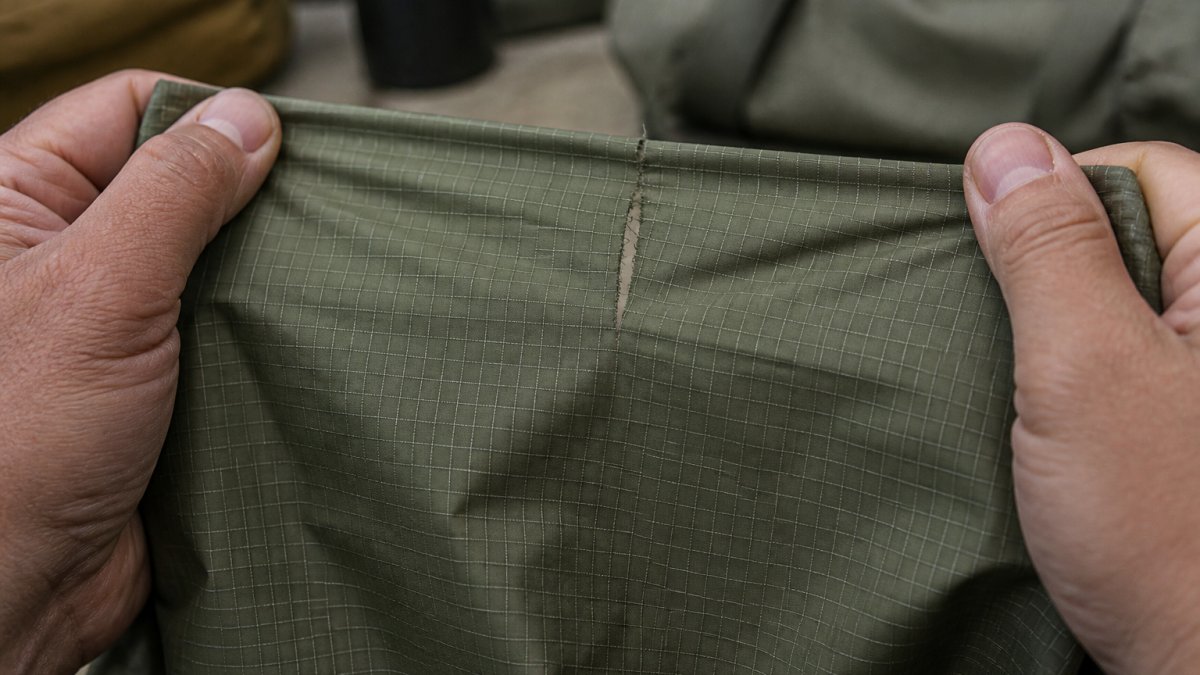
Here's how it works: Make a small, controlled cut along the ripstop weave. Then apply tension perpendicular to the cut. A quality ripstop fabric will hold the tear at the grid intersection. A weak one will let the tear run across multiple squares.
How the Ripstop Grid Affects Tear Spread
The ripstop construction uses thicker nylon threads woven in a grid pattern, usually every quarter-inch to half-inch. When a tear hits one of those thicker threads, it should stop or significantly slow down.
If the grid spacing is too wide, a tear can run between squares. If the reinforcement thread is too thin, it won't have enough strength to stop propagation.
How to perform the tear propagation test:
- Cut a small slit (about 1 inch) along one of the grid lines using sharp scissors or a utility knife
- Hold the fabric taut with both hands, applying steady tension perpendicular to the cut
- Observe whether the tear stops at the next grid intersection or continues across multiple squares
- Repeat in three different locations to account for variations in the weave
What to look for: A quality ripstop fabric will stop the tear within one grid square. The tear resistance should be consistent across the sample.
Test 2: Abrasion Resistance Evaluation for Ripstop Fabric
Abrasion resistance tells you how long the fabric will last under repeated rubbing and contact. This matters for gear that gets dragged across rocks, brushed against tree bark, or packed against rough surfaces.
The standard lab test uses a machine that rubs fabric samples with a specific weight and pattern. You can approximate this at home with controlled manual testing.
Measuring Wear After Repeated Rubbing
Abrasion happens in two ways: the coating wears through first, exposing the base fabric underneath. Then the base fabric itself starts to break down.
When you rub the fabric, you're testing both the coating durability and the base weave strength. A fabric that shows visible pilling or fuzzing after light rubbing has weak fibers. A fabric that shows coating wear but maintains structural integrity is acceptable for most uses.
How to perform the abrasion resistance test:
- Use a piece of 120-grit sandpaper or a rough cotton cloth
- Place the fabric flat on a hard surface
- Rub the sandpaper or cloth across the fabric in one direction with moderate pressure (about the weight of your hand)
- Count the number of passes until visible wear appears
- Continue until the coating is noticeably compromised or the base fabric shows damage
What to look for: Quality ripstop fabric should withstand 50-100 passes with sandpaper before the coating shows significant wear. The base fabric underneath should remain intact even after the coating is partially worn through.
Test 3: The Water Repellency and Ripstop Fabric Waterproof Test
Water repellency is measured by something called DWR (durable water repellent) treatment. This is a coating applied to the fabric surface that makes water bead up and run off instead of soaking in.
The key word is "durable." DWR treatment breaks down with washing, body oils, dirt, and UV exposure. A fabric that sheds water when new might absorb water after five washings. Testing this before and after simulated washing tells you how long the water repellency will actually last.
Assessing DWR Durability After Washing
The DWR test is straightforward: you spray water on the fabric and observe whether it beads up or soaks in. The challenge is understanding what you're looking at. Some water absorption is normal and acceptable.
A properly treated ripstop fabric should shed water initially, then gradually absorb more water with each wash cycle. The question is how many cycles before it becomes water-resistant instead of waterproof.
How to perform the water repellency test:
- Fill a spray bottle with clean water
- Spray the fabric surface from 6 inches away, using 5-10 quick bursts
- Observe whether water beads up and rolls off or soaks into the fabric
- Repeat the test after washing the fabric in warm water with mild detergent (simulate field use)
- Repeat again after 3-5 additional wash cycles
What to look for: New ripstop fabric should show clear beading and water shedding. After one wash, beading should still be visible.
“Trooper” MultiCam/OCP 3-Side Zippered Poncho Liner with Headport & Stuff Pad →
Test 4: Seam Strength Evaluation with the Fabric Seam Strength Test
Seams are the first place gear fails. A strong ripstop fabric with weak seams is useless. The seam strength test measures how much load a seam can handle before the stitching fails or the fabric tears at the seam line.
This test requires controlled tension equipment, so it's not practical for home testing.
How to assess seam strength:
- Examine the seam visually: look for consistent stitch spacing (about 8-12 stitches per inch for outdoor gear), tight thread tension, and reinforcement stitching on high-stress seams
- If you have a sample, cut a 2-inch square with a seam running through the center
- Hold one side of the fabric and pull the other side with steady tension until the seam fails
- Observe whether the stitching pulls out, the thread breaks, or the fabric tears at the seam line
What to look for: Quality outdoor gear has 10-12 stitches per inch with reinforcement stitching (two or three parallel rows) on all stress points. The thread should break before the stitching pulls out.
Test 5: Tensile Strength and Breaking Point Assessment
Tensile strength measures the maximum load a fabric can handle before it tears or fails. This is typically measured in pounds per inch of width.
For ripstop fabric used in outdoor gear, tensile strength usually ranges from 50 to 200 pounds per inch depending on the denier and weave.
Testing tensile strength requires lab equipment, but you can estimate fabric strength by examining the denier (thread weight) and weave tightness.
What to look for: Outdoor gear should use ripstop fabric with tensile strength of at least 80-100 pounds per inch. Ultralight backpacking gear might use 50-70 pounds per inch.
Test 6: Colorfastness and Pilling Resistance Check
Colorfastness measures whether the dye stays in the fabric or bleeds out during washing and exposure to sunlight. Pilling is the formation of small fiber balls on the fabric surface, which happens when loose fibers break and tangle together.
Both of these are visual indicators of fabric quality. A fabric that fades quickly or pills easily is made from lower-quality materials or has a loose weave.
How to perform the colorfastness and pilling test:
- Wash a sample of the fabric in warm water with detergent
- Observe the wash water: if it's deeply colored, the dye is bleeding out
- After drying, compare the fabric color to the original, significant fading indicates poor colorfastness
- Rub the fabric surface vigorously with a soft cloth and examine for pilling
- Place the fabric in direct sunlight for 24-48 hours and repeat the color comparison
What to look for: Quality ripstop fabric should show minimal color bleeding in the first wash and no significant fading after 5-10 washes. Pilling should be minimal or absent even after vigorous rubbing.
Test 7: Visual Inspection and Light Transmission Analysis
The final test is the simplest: look at the fabric. Hold it up to light and examine the weave pattern, coating consistency, and overall construction quality.
This test requires no equipment and takes five minutes, but it reveals a lot about how the fabric was made and whether it will hold up.
How to perform the visual inspection test:
- Hold the fabric up to a bright light source (window, lamp, or flashlight)
- Look for consistent weave patterns: the grid should be regular and tight
- Check for thin spots or areas where the coating is uneven
- Examine both sides of the fabric: the coating should be smooth and consistent
- Look for loose threads, tears, or manufacturing defects
What to look for: Quality ripstop fabric shows a tight, regular weave with consistent grid spacing. The coating should be smooth and even across the entire surface. When held to light, you should see a uniform pattern without thin spots or dark areas that indicate uneven coating.
Testing ripstop fabric durability before you buy protects your investment and ensures the gear will perform when it matters. At Dragoon Unlimited, our poncho liners, like the Trooper MultiCam 3-Side Zippered Poncho Liner, are built from weather-resistant polyester with reinforced seams and a tight ripstop grid designed to stop tears and shed water.

Frequently Asked Questions
How can you test ripstop fabric durability at home?
You can perform seven practical tests at home: tear propagation (initiate a small tear and measure how far it spreads), abrasion resistance (rub the fabric repeatedly with a weighted cloth), water repellency (pour water onto the surface and observe beading), seam strength (pull on stitched seams with measured force), tensile strength (stretch the fabric to its breaking point), colorfastness (wash and check for fading), and visual inspection under light (examine for pilling, coating degradation, or thin spots). Each test reveals specific durability characteristics and requires only basic tools. Document your results with measurements or photos to compare fabrics objectively.
What is ripstop fabric tear resistance and why does it matter?
Ripstop fabric tear resistance is the fabric's ability to stop a tear from spreading once it begins. The reinforced grid pattern in ripstop fabric interrupts tear propagation, containing damage to a small area rather than allowing it to rip across the entire panel. This matters because field gear encounters sharp branches, rough handling, and accidental punctures. A fabric that resists tear propagation keeps your shelter, sleeping system, or pack intact during use. Testing tear resistance reveals whether the ripstop construction is effective or if the grid spacing is too wide to contain damage.
Does ripstop fabric lose durability after washing?
Yes, ripstop fabric can lose durability after washing, particularly in water repellency and coating integrity. The DWR (durable water repellent) coating applied to ripstop fabric degrades with repeated washing, detergent exposure, and heat. Seams may weaken if washed in hot water or dried at high heat. Abrasion resistance can diminish if the fabric is scrubbed aggressively. To preserve durability, wash ripstop gear in cold water, use mild detergent, air dry, and reapply DWR treatments periodically. Testing fabric before and after washing reveals how much durability loss occurs under your specific care routine.
What tests reveal a fabric's abrasion resistance?
Abrasion resistance tests measure how well fabric withstands repeated rubbing and surface wear. The double-rub test (or Martindale test) involves rubbing the fabric with a weighted cloth in a circular motion and counting repetitions until visible wear appears. A DIY version uses sandpaper or a rough cloth weighted with a known mass, rubbed across the fabric surface for a set number of strokes. Testing abrasion resistance is critical for gear that contacts rough terrain, backpack straps, or constant handling.
How is ripstop fabric waterproof durability measured?
Ripstop fabric waterproof durability is measured by testing water repellency before and after washing, and by assessing the coating's resistance to degradation. The spray test applies water droplets to the fabric surface; repellent fabric causes water to bead and roll off, while degraded fabric absorbs water. The hydrostatic pressure test measures how much water pressure the fabric can withstand before water penetrates. DWR durability tests involve repeated washing cycles followed by spray tests to track when the coating loses effectiveness.


