


Table of Contents
- Why Rain Gear Fails on Multi-Day Treks
- Breathability vs Waterproof Ratings: What the Numbers Actually Mean
- Poncho Rain Gear: Light, Cheap, and Underrated
- Poncho vs Rain Jacket Pros and Cons for Trekking
- Venting, Seams, and Fit: The Details That Decide Comfort
- Climate-Based Selection: Match Gear to Your Route
- Field Repairs and DWR Maintenance on the Trail
- Conclusion: Building a System That Lasts the Whole Route
- Frequently Asked Questions
Last Updated: September 11, 2026
Why Rain Gear Fails on Multi-Day Treks
Rain gear rarely fails on day one. It fails on the fourth, when the membrane has packed out, the seams weep, and the inside of your jacket is a swamp. Choosing rain gear for long distance trekking is a different discipline from picking a jacket for a weekend hike, and this guide from Dragoon Unlimited covers the trade-offs that decide whether you stay dry over hundreds of miles.

A common mistake is buying for the worst hour of rain rather than the hundredth hour of wear. Multi-day precipitation is cumulative, and the failure points are predictable: condensation, seam fatigue, and a durable water repellent that stops beading long before the trip ends.
Below, we break down waterproof ratings, poncho rain gear, venting, and field maintenance so you can pick gear that survives the whole route.
Breathability vs Waterproof Ratings: What the Numbers Actually Mean
Hydrostatic head measures how much water pressure a fabric resists before it leaks, expressed in millimeters. Moisture vapor transmission rate (MVTR) measures how much water vapor escapes through the fabric in a set period. A high hydrostatic head keeps rain out; a high MVTR keeps your own sweat from soaking you from the inside.
The useful part is understanding how the numbers are produced, what they predict, and how the trade-off plays out over a multi-week trek.
How the Numbers Are Actually Generated
Hydrostatic head is measured with a column of water pressed against a fabric sample until three drops appear on the underside; the column height at that moment, in millimeters, is the rating. A 10,000 mm fabric held a 10-meter column before leaking; a 20,000 mm fabric held 20 meters (peer-reviewed research). The test is static and clean, no pack straps, abrasion, flexing, or body oils degrading the membrane.
MVTR is measured differently depending on the standard. The two quoted most often are the RET value (lower is better, under 6 is very breathable, 6-13 average, above 13 clammy) and the g/m²/24hr figure (higher is better) (peer-reviewed research). Because labs use different methods, an MVTR number from one brand isn't directly comparable to another. Treat any single breathability figure as a rough tier, not a precise spec.
What the Ratings Predict, and What They Don't
A high hydrostatic head predicts resistance to sustained, wind-driven rain and to pressure points like pack straps and kneeling. It does not predict how the fabric behaves after a hundred hours of flexing, or how the seams hold up. A 20,000 mm jacket with poor seam taping can leak sooner than a 10,000 mm jacket with welded seams.
MVTR predicts vapor movement under ideal lab conditions. It does not predict how the jacket breathes once the DWR fails and the face fabric wets out, the outer layer saturates, the membrane sits between two wet surfaces, and vapor movement drops sharply regardless of the rated number. This is the most common reason a jacket that felt breathable on a day hike becomes a sauna on day four of a wet trek.
The Trade-Off, Stated Plainly
Membranes that block more water tend to move less vapor. The relationship isn't perfectly linear, but it's real, and it's why the highest hydrostatic head jackets are rarely the most breathable. Three practical consequences for long-distance trekking:
- You don't need the highest number. For most three-season trekking, 10,000-20,000 mm hydrostatic head is sufficient (rei.com). Ratings above that are aimed at mountaineering, prolonged pressure from pack straps, or sitting on wet ground.
- Breathability matters more than waterproofing on warm, humid routes. If you're sweating hard in 70°F rain, a 15,000 mm / high-MVTR shell will keep you drier overall than a 30,000 mm / low-MVTR shell, because the limiting factor is your own vapor, not the rain.
- Ventilation features can compensate for a lower MVTR. Pit zips, mesh-lined pockets, and two-way front zippers move more moisture than the membrane difference between two mid-tier fabrics. A jacket with a modest MVTR and good pit zips often outperforms a higher-MVTR jacket with none.
Reading a Spec Sheet Without Getting Fooled
When you compare jackets, look for the test standard alongside the number, an MVTR figure without a stated method is marketing, not data. Check whether the hydrostatic head is quoted for the fabric or the seams (seam ratings are usually lower). And weigh ventilation design as heavily as the membrane spec, because on a long trek the vents are what you'll actually adjust.
Poncho Rain Gear: Light, Cheap, and Underrated
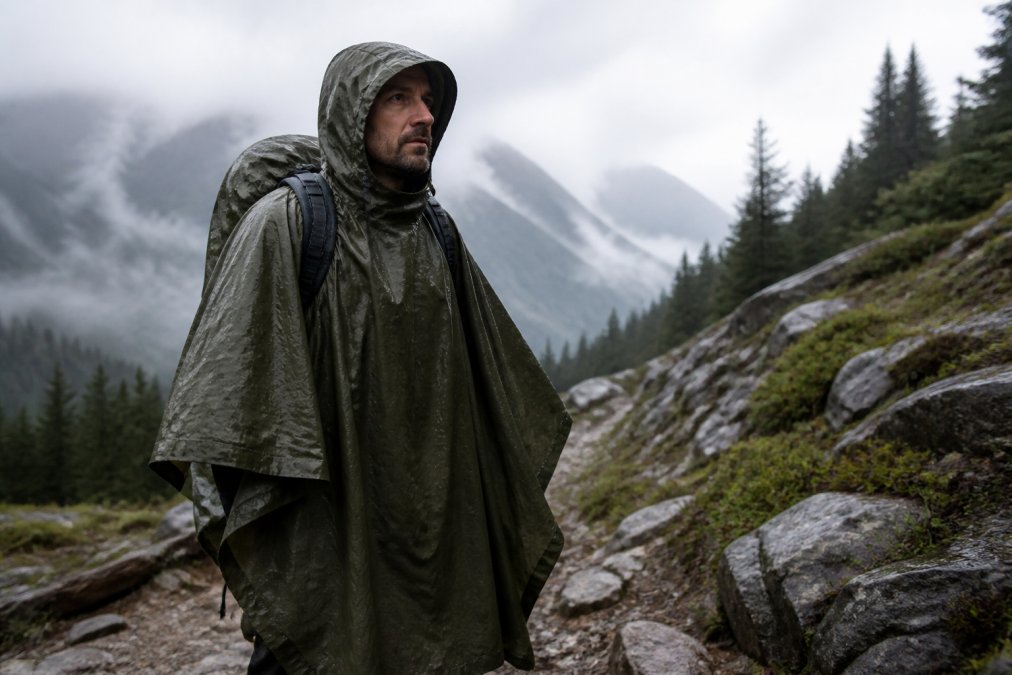
Poncho rain gear is the lightest, most packable option for long-distance trekking, and it covers your pack as well as your body. For warm-weather routes, a poncho often outperforms a technical hardshell because it vents freely and weighs almost nothing.
When a Poncho Beats Everything Else
A poncho wins in three situations: humid climates where breathability matters more than storm protection, routes with frequent light rain you'll be taking on and off all day, and trips where pack weight is the deciding factor. It loses in high wind, where it flaps and exposes your arms, and in sustained sideways rain.
For those conditions, a layered system works better. A poncho liner, like the Trail Rider from Dragoon Unlimited, adds a warm, water-resistant layer you can pair with a shell or use alone around camp.

Poncho vs Rain Jacket Pros and Cons for Trekking
The poncho versus rain jacket pros and cons come down to coverage, ventilation, and weight. A poncho covers you and your pack, breathes well, and packs small, but flaps in wind and leaves your arms exposed. A rain jacket seals you in with taped seams, a storm hood, and cuff adjustments, but traps heat and costs more.
| Feature | Poncho | Rain Jacket |
|---|---|---|
| Weight | Very light | Light to moderate |
| Pack coverage | Full | None |
| Wind resistance | Poor | Strong |
| Ventilation | Excellent | Depends on pit zips |
| Arm protection | Minimal | Full |
| Cost | Low | Higher |
Choose a poncho for warm, wet, low-wind routes. Choose a jacket when wind, cold, or sustained downpours are on the forecast.
Venting, Seams, and Fit: The Details That Decide Comfort
Venting, seams, and fit decide whether a jacket keeps you dry in practice. Pit zips dump heat on a climb, taped seams stop water wicking through stitch holes, and articulated elbows and a storm hood keep fabric where you need it while moving.
What most guides miss is that fit drives breathability. A jacket that's too tight compresses the membrane against your base layer and kills airflow. Look for room to layer a wicking base layer underneath without the shell ballooning. Cuff adjustments and a well-shaped hood matter more than a marginal bump in hydrostatic head.
Climate-Based Selection: Match Gear to Your Route
Most rain gear guides treat "rain" as one condition. On a long-distance trek, the climate you walk through changes what "good rain gear" means more than any brand or price tier. The same jacket that's ideal for cold alpine precipitation can be dangerous in humid tropical rain, and vice versa. This section matches membrane and construction to the precipitation regime you'll actually encounter.
Humid, Warm Rain (Tropical and Temperate Summer)
Here the rain is often warm, heavy, and short, and the real threat is overheating, not cold. Your body produces more vapor than the rain produces water pressure. Priorities shift:
- Breathability over hydrostatic head. A 10,000-15,000 mm shell with high MVTR beats a 30,000 mm shell that traps heat.
- Ponchos and rain skirts genuinely compete here. They vent freely, cover the pack, and weigh almost nothing. In low-wind tropical rain, a poncho is often the correct answer, not a compromise.
- Avoid fully taped, heavy hardshells. They seal in heat and vapor, and you'll be wet from the inside within an hour of climbing.
- DWR matters less. In warm rain, a wetted-out face fabric is uncomfortable but not dangerous. You can defer re-treatment until you're back in town.
Cold, Wind-Driven Rain (Coastal, Maritime, Shoulder-Season)
This regime punishes bad gear. Rain is cold, often horizontal, and sustained for days. The threat is hypothermia, and the failure mode is a wet base layer you can't dry out.
- Prioritize hydrostatic head and seam integrity. 20,000 mm and above, with fully taped or welded seams. Wind-driven rain finds every stitch hole.
- Pit zips and a storm hood are non-negotiable. You need to dump heat on climbs without exposing your core to the wind.
- A rain skirt or full rain pants matter. Cold rain running down your legs into your boots is a multi-day problem, not a comfort issue.
- DWR is a safety feature here. Once the face fabric wets out in cold wind, the jacket stops breathing and you get cold fast. Re-treat before the trip and carry a small DWR spray.
Alpine and Exposed Terrain
Alpine precipitation mixes rain, sleet, and wet snow, and the terrain adds abrasion from rock and pack straps. Priorities:
- Three-layer construction. A separate face fabric, membrane, and liner resists abrasion and pack-strap pressure far better than a two-layer or 2.5-layer jacket.
- Higher hydrostatic head (20,000 mm+). You'll be under a loaded pack for hours, and pressure points are where leaks start.
- A helmet-compatible hood and articulated sleeves. You need to move your arms overhead without the hem riding up.
- Rain pants with reinforced knees and seat. Glissading, sitting on wet rock, and scrambling all wear through thin fabric fast.
Arid and High-Desert Routes
Rain here is rare, intense, and brief. The calculus flips again:
- Weight and packability dominate. You're carrying rain gear for hundreds of dry miles for the handful of storms you'll hit.
- A lightweight 2.5-layer shell or a poncho is usually enough. You don't need alpine durability for a 20-minute desert downpour.
- Watch for flash-flood conditions. The gear decision is secondary to route timing; a lightweight shell that packs to the size of a fist is the right call.
The Decision Sequence
Rather than picking a jacket and hoping it fits your route, work backward from the worst realistic conditions:
- Identify the dominant precipitation regime for the majority of your trek days, not the single worst storm.
- Set a hydrostatic head floor based on whether you'll be under a loaded pack in sustained rain (higher) or in brief warm showers (lower).
- Set a breathability floor based on how hard you'll be working and how warm the rain is.
- Choose ventilation features to cover the gap between your breathability floor and what the membrane delivers.
- Add lower-body protection matched to the regime, rain skirt for warm, rain pants for cold, gaiters for alpine.
Field Repairs and DWR Maintenance on the Trail
Field maintenance keeps rain gear working when you can't replace it. Durable water repellent (DWR) makes water bead and roll off; when it wears out, the fabric "wets out," feels clammy, and stops breathing. Restore it with a wash and a spray-on or wash-in DWR treatment.
Carry a small repair kit: seam tape or a patch, a needle, and cord. Taped seams and small punctures can be patched in the field well enough to finish a route. A shelter that fails is a bigger problem than a jacket, which is why a rugged, field-tested option like the Ridgeback one-person shelter earns its place in a long-distance kit.

Conclusion: Building a System That Lasts the Whole Route
Choosing rain gear for long distance trekking is about building a system: a breathable shell or poncho matched to your climate, a warm mid-layer, and a maintenance routine that keeps DWR and seams working. Get those three right and the weather stops dictating your trip.
Frequently Asked Questions
Are ponchos or raincoats better for long-distance trekking?
Ponchos win on ventilation and packability; rain jackets win on wind resistance and mobility. A poncho lets air circulate freely, which reduces condensation inside the garment during sustained effort. A jacket with pit zips and taped seams handles high winds and brush better. Many long-distance trekkers carry a poncho as their primary shell in warm, wet climates and switch to a jacket in exposed, windy terrain. Your route and expected weather should drive the choice.
How do you determine the waterproof rating needed for multi-day treks?
Look at the hydrostatic head rating, measured in millimeters. A 1,500 mm rating handles light rain; 5,000 mm covers steady rain; 10,000 mm or higher is appropriate for sustained storms and pressure from pack straps. For multi-day treks where you cannot dry out, aim for at least 10,000 mm and fully taped seams. Breathability matters just as much: a high waterproof rating with poor moisture vapor transmission rate leaves you soaked from sweat.
Is a poncho more breathable than a traditional rain jacket?
Yes, in most cases. A poncho is open at the sides and bottom, so body heat and moisture escape without passing through the fabric. A rain jacket relies on membrane technology and venting features like pit zips to move moisture vapor out. That said, a poncho's open design also means wind can lift it and rain can reach your arms and legs. For high-output trekking in warm rain, a poncho often keeps you drier overall because condensation is less of a problem.
What features should I look for in durable, long-distance rain gear?
Prioritize taped seams, a storm hood with adjustable drawcords, cuff adjustments, and articulated elbows for mobility. Check the denier of the face fabric: higher denier means better abrasion resistance when brushing against rocks and branches. A durable water repellent finish keeps the outer fabric from wetting out. Packability matters too, since you may carry the shell for days without using it. Three-layer construction generally outlasts two-layer, but weighs more.
Gear failure in the backcountry is terrifying, and the fix starts with equipment built to hold up when it counts. At Dragoon Unlimited, every piece is field-tested and designed with input from the people who use it, from the Ridgeback one-person shelter to the Trail Rider poncho liner. We're a veteran-owned operation, and we donate a portion of proceeds to organizations supporting veterans. Get started with Dragoon Unlimited and carry gear you can trust for the whole route.


