


Table of Contents
- Why Outdoor Enthusiasts Look Beyond Standard Military Poncho Liners
- History and Evolution of the Military Poncho Liner
- Synthetic Insulated Camping Blankets as Modern Alternatives
- How to Choose a Field Blanket for Your Needs
- Poncho Liner vs Fleece Blanket: Which Performs Better
- Dragoon Unlimited Poncho Liners: Field-Tested Alternatives
- Ultralight Quilted Systems for Backpacking and Bushcraft
- Sustainability and Eco-Friendly Gear Options
- Frequently Asked Questions
Last Updated: September 25, 2026
Why Outdoor Enthusiasts Look Beyond Standard Military Poncho Liners
Alternatives to military poncho liners are gaining traction among hikers, preppers, and tactical enthusiasts who demand more versatility, better thermal performance, or modern features that surplus gear simply doesn't offer.
The traditional military woobie works, but wasn't designed for modern camping, bushcraft, or ultralight backpacking. Dragoon Unlimited engineered zippered poncho liners that function as sleeping bags, wearable serapes, emergency shelters, and field blankets all at once.

Outdoor enthusiasts now expect gear that adapts to their mission. This guide breaks down alternatives to standard military poncho liners and which solutions deliver in the field.
History and Evolution of the Military Poncho Liner
The military poncho liner emerged as a lightweight insulation layer for soldiers, paired with a waterproof shell and polyester batting. The design prioritized weight savings and packability over specialized thermal zones or modern conveniences.
The design was rugged and proven, but had real limitations: it required a separate poncho shell, offered no way to seal in warmth, and provided no head coverage when worn as a blanket.
Aftermarket manufacturers like Dragoon Unlimited reimagined the woobie by adding zippered construction, integrated head ports, and stuff sacks, transforming it into a complete sleep system that solved long-standing field problems.

Synthetic Insulated Camping Blankets as Modern Alternatives
Synthetic insulated camping blankets represent the most direct alternative, combining polyester batting with design improvements that address real-world use cases.
Material Composition: Rip-Stop Nylon and Polyester Batting
Modern alternatives use rip-stop nylon shells paired with polyester batting. Rip-stop nylon resists tearing and sheds moisture, while polyester batting provides loft without absorbing water.
Rip-stop fabric handles rough handling without failing, and polyester batting retains insulation when damp, keeping gear functional in wet conditions.
Dragoon Unlimited's zippered poncho liners use polyester construction, which sheds wind, moisture, and dirt with ease.

Thermal Efficiency and Temperature Ratings
Temperature ratings indicate where a blanket keeps you warm. Thermal efficiency comes from loft depth and batting density, but thicker layers add weight and reduce packability.
A heavier blanket provides maximum warmth; a lighter one prioritizes packability. Choose based on your mission: winter mountaineering demands thermal insulation; three-season backpacking prioritizes weight savings.
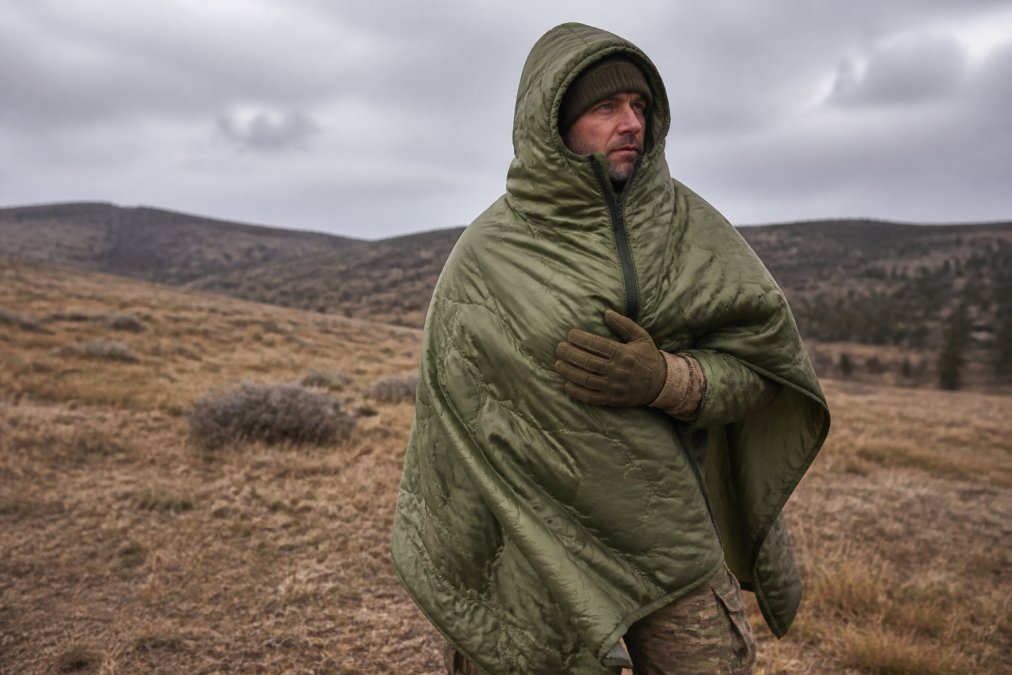
Dragoon Unlimited's zippered poncho liners provide consistent warmth across moderate to cool conditions. The three-sided zipper creates a cocoon that eliminates heat loss, while the integrated head port seals heat around your upper body.
How to Choose a Field Blanket for Your Needs
Choose a field blanket based on expected temperature range, weight capacity, and intended use.
Match your blanket's thermal efficiency to the coldest conditions you'll face.
Evaluate weight-to-warmth ratio, how much warmth relative to weight. Balance thermal performance against mobility based on your use case.
Finally, consider versatility. Will you use this as a primary sleep system, a supplementary layer, or emergency gear? Will you wear it as a poncho, wrap it as a blanket, or convert it into a bivy-style cover? The more functions your gear serves, the more value it delivers per ounce carried.
Weight-to-Warmth Ratio and Packability
Weight-to-warmth ratio is the metric that separates practical field gear from theoretical designs. A blanket that weighs three pounds but provides minimal warmth is useless. A blanket that weighs two ounces but only works in mild conditions won't keep you alive in an emergency.
Packability matters equally. Gear that doesn't compress into a manageable size becomes a liability in the field. You'll leave it behind or struggle under its bulk, defeating its purpose. Dragoon Unlimited's zippered poncho liners compress into a compact stuff sack, fitting easily into a rucksack or bug-out bag alongside other essentials.
The most practical field blankets achieve balance: enough loft to provide genuine thermal protection, enough packability to carry without burden, and enough durability to handle repeated use in harsh conditions.
“Trooper” MultiCam/OCP 3-Side Zippered →
Durability and Long-Term Wear Testing
Durability separates gear that works once from gear that works for years. Real field testing reveals which blankets maintain their insulative properties after repeated use, compression, and exposure to moisture.
Rip-stop nylon shells resist tearing better than standard fabrics, but they're not invincible. Sharp branches, rough handling, and extended field use will eventually stress any material. The quality of seams, the robustness of zippers, and the integrity of attachment points all determine how long a blanket will function reliably.
Polyester batting degrades over time when exposed to UV light and moisture. High-quality batting maintains its loft retention through multiple seasons of use. Lower-quality batting compresses and loses effectiveness after a few field deployments. This is why testing matters: you need to know whether a blanket will perform in year two the way it performed in year one. Consistent thermal regulation often requires moving beyond simple liners toward high quality sleeping bags that provide more reliable insulation for long-term field operations.
Poncho Liner vs Fleece Blanket: Which Performs Better
The comparison between poncho liners and fleece blankets reveals fundamental differences in design philosophy and real-world performance.
Fleece blankets provide comfort and packability but lack the weather-resistant shell that makes poncho liners functional in wet conditions. A fleece blanket absorbs moisture, becomes heavy when damp, and loses insulative value when wet. A poncho liner's polyester shell sheds water, keeping the batting dry and maintaining thermal performance.
Poncho liners also offer versatility that fleece blankets can't match. You can wear a poncho liner as a serape, wrap it as an emergency shelter, or convert it into a sleeping bag with zippered construction. A fleece blanket does one thing: provide warmth when dry. In the field, that limitation becomes a liability.
The thermal efficiency argument favors fleece in dry conditions. Fleece's cellular structure traps air effectively and feels warmer at lower weights. But introduce moisture, rain, snow, condensation from your breath, and the advantage disappears. Synthetic batting in a weather-resistant shell outperforms fleece in real field conditions because it stays functional when conditions deteriorate.
For outdoor enthusiasts who operate in variable weather, poncho liners deliver superior performance. They handle moisture better, offer more versatility, and maintain functionality across a wider range of conditions.
Dragoon Unlimited Poncho Liners: Field-Tested Alternatives
Dragoon Unlimited engineered zippered poncho liners specifically to address the limitations of standard military surplus gear. Every design decision reflects field experience and customer feedback from veterans, preppers, hunters, and outdoor adventurers.
The "Trooper" MultiCam/OCP model and our other zippered variants start at $69.99 and deliver features that surplus gear doesn't offer. The three-sided zipper converts the blanket into a lightweight sleeping bag or bivy-style cover. The zippered head port allows you to wear it as a poncho insert or serape-style wrap. The included headpad adds comfort and support during rest. Polyester construction sheds wind, moisture, and dirt with ease.
What separates our poncho liners from standard military versions is the engineering. We didn't just add a zipper to surplus gear. We redesigned the entire product around real field use cases. The result is gear that functions as a sleep system, emergency shelter, and wearable layer, three critical capabilities in one compact package.
Zippered Design and Multi-Use Versatility
The three-sided zipper is the game-changer. It transforms a flat blanket into a functional sleeping bag without the weight and bulk of a traditional quilt. When sealed, it creates a cocoon that retains body heat and prevents drafts. When open, it functions as a standard blanket or can be worn as a serape.
This versatility matters in the field.
Camo Patterns and Colorways for Different Environments
Field effectiveness depends partly on visual concealment. Dragoon Unlimited offers multiple camo patterns: MultiCam/OCP for modern tactical environments, Woodland for traditional forest settings, Rhodesian Brushstroke for varied terrain, and MARPAT for those with Marine Corps heritage.
Ultralight Quilted Systems for Backpacking and Bushcraft
Ultralight quilted systems represent a different category of alternatives to traditional poncho liners. These purpose-built sleep systems prioritize weight savings and thermal efficiency for backpacking and bushcraft applications.
Sustainability and Eco-Friendly Gear Options
Sustainability has become a genuine consideration for outdoor enthusiasts. The environmental impact of synthetic materials, manufacturing processes, and product longevity all factor into responsible gear selection.
Frequently Asked Questions
What makes synthetic insulated camping blankets better than standard military poncho liners?
Synthetic insulated camping blankets offer superior loft retention, moisture-wicking properties, and faster drying times compared to traditional wool or basic polyester liners. Modern synthetic fill maintains thermal insulation even when damp, a critical advantage in wet conditions. Dragoon Unlimited's zippered poncho liners ($64.99-$69.99) combine polyester construction, delivering weather resistance and packability that standard issue gear cannot match. The three-sided zipper and integrated head port add versatility for layering systems and emergency shelter use.
How do I choose a field blanket that will actually hold up in the backcountry?
Focus on weight-to-warmth ratio, durability testing, and real-world use cases. Look for rip-stop nylon construction that resists tears and abrasion from branches and rocky terrain. Check temperature ratings and loft retention data, synthetic fills should maintain insulation after compression and moisture exposure. Dragoon Unlimited poncho liners are field-tested by veterans and outdoor professionals, include stuff sacks for compact storage, and feature secure tie points for deployment. Test gear on shorter trips before relying on it for extended backcountry missions.
Is a poncho liner vs fleece blanket, which should I carry for cold weather camping?
Poncho liners outperform fleece blankets in versatility and thermal efficiency. Fleece retains moisture and loses insulation when wet; poncho liners with polyester batting shed moisture and dry quickly. Dragoon Unlimited's zippered design converts a poncho liner into a bivy-style sleeping bag or wearable serape, while fleece blankets offer only basic coverage. For weight-conscious backpackers and ultralight bushcraft, poncho liners provide superior packability. Fleece works best as a mid-layer garment, not a primary sleep system. For field use, poncho liners deliver better performance across temperature ranges and weather conditions.
Can a modern poncho liner replace a dedicated sleeping bag for three-season camping?
Modern zippered poncho liners can function as sleeping bags in three-season conditions (spring through fall), especially when layered with other insulation. Dragoon Unlimited's three-sided zipper converts the liner into a lightweight bivy-style cover with integrated head port, eliminating the need for external modifications. Pair it with an under-quilt or over-quilt system for enhanced thermal efficiency. However, dedicated ultralight quilts designed for specific temperature ratings offer better insulation precision. For emergency preparedness and multi-use field gear, poncho liners excel; for dedicated winter camping, a purpose-built sleeping bag remains superior.


