


Table of Contents
- What Is a Woobie and Why It Matters for Camping
- Woobie vs Sleeping Bag: Which Offers Better Value
- Woobie vs Wool Blanket: Performance and Practicality
- Are Woobies Warm Enough for Real Camping Conditions
- Woobie Blanket Price and Cost-Per-Use Analysis
- Durability, Weight, and Packability: The Real-World Test
- Is a Woobie Worth the Money? The Verdict
- Frequently Asked Questions
Last Updated: October 5, 2026
What Is a Woobie and Why It Matters for Camping
A woobie is a lightweight, quilted insulated blanket originally designed for military use. Also called a poncho liner, it works as a standalone blanket or a layer inside a military poncho, making it popular with campers for its versatility and packability.
The woobie began as military surplus gear that could do multiple jobs without adding weight to a ruck, and it has since become a civilian camping essential.
The answer depends on your camping style, climate, and how you plan to use it. A woobie excels as a layering piece, works well in mild to cold weather, and packs down smaller than most sleeping bags, but has real limits in extreme cold and wet conditions.
Woobie vs Sleeping Bag: Which Offers Better Value
The comparison comes down to versatility versus specialization. A sleeping bag is engineered for one job: keeping you warm while you sleep. A woobie does that reasonably well but also works as a poncho, emergency shelter, or layering component.
Sleeping bags offer better insulation in extreme cold because their construction, loft, and materials are optimized for temperature ratings.
Woobies win on weight and packability. A woobie stuffs into a compact sack, weighs less than most sleeping bags, and suits ultralight backpacking.
For car camping where weight isn't critical, a sleeping bag is the safer choice. For backpacking trips where every ounce matters, a woobie makes more sense.
| Feature | Woobie | Sleeping Bag |
|---|---|---|
| Weight | 1-2 lbs | 2-4 lbs |
| Packed Size | 12-16 inches | 18-24 inches |
| Temperature Rating | None (estimated 40-60°F) | Rated to specific temps |
| Versatility | Poncho, shelter, layer | Sleep system only |
| Price Range | $65-70 | $150-400+ |
| Best For | Layering, ultralight trips | Cold weather, car camping |
Woobie vs Wool Blanket: Performance and Practicality
Wool blankets are heavier, bulkier, and less packable than woobies, but retain warmth even when damp, which is why military personnel and outdoor veterans often favor them for wet-weather camping.
The woobie's synthetic insulation (typically polyester) loses effectiveness when wet, a significant limitation in rain or near water.
Packability strongly favors the woobie. A wool blanket weighs 3-5 pounds and takes up substantial pack space, while a woobie weighs 1-2 pounds and compresses to water-bottle size.
Cost also differs. A quality wool blanket runs $80-150, while a woobie costs $65-70.
Are Woobies Warm Enough for Real Camping Conditions
This is the critical question when evaluating whether is a woobie worth the money for camping. A woobie provides genuine warmth within limits, effective in mild to moderate cold, roughly 40 to 60 degrees Fahrenheit alone.
The problem: woobies don't come with official temperature ratings, since manufacturers don't test them to sleeping bag standards. You're estimating warmth from user reports and insulation thickness, not verified data.
A Practical Temperature Band Guide
Since there's no standardized rating, the most useful thing you can do is map a woobie to realistic conditions. The bands below assume a healthy adult, a closed-cell or inflatable pad underneath, and dry conditions, practical guidance, not lab-tested ratings.
| Overnight Low | Woobie Alone | Woobie + Base Layer | Woobie + Sleeping Bag |
|---|---|---|---|
| 60°F and above | Comfortable, may be too warm | Overkill | Overkill |
| 50-59°F | Comfortable for most | Comfortable | Overkill |
| 40-49°F | Marginal, cold spots at hips and shoulders | Comfortable | Comfortable |
| 32-39°F | Not sufficient | Marginal | Comfortable |
| Below 32°F | Not sufficient | Not sufficient | Works as an added layer |
Experienced campers note the woobie's real weakness is the ground, not the top layer. Cold seeps up through the pad, and the synthetic fill compresses flat under body weight, so the same woobie that feels warm at 45°F on a thick pad can feel cold at 50°F on a thin one.
How Layering Actually Works
Experienced campers layer the woobie three ways, each changing the effective temperature range:
- Under you, on the pad. Placing the woobie between your body and the sleeping pad blocks conductive heat loss to the ground. This is the highest-value use in cool weather and can add roughly 5-10°F of perceived warmth.
- Over you, as a top quilt. Used as a blanket over a base layer, the woobie traps body heat but leaves gaps at the edges. Tucking the edges under you or using the three-sided zipper to close it into a bag shape reduces drafts significantly.
- Inside a sleeping bag. A woobie stuffed inside a 30°F or 20°F bag adds meaningful loft and can extend that bag's comfortable range by roughly 10°F for many users. This is the configuration most likely to keep you warm below freezing.
Used alone on a pad at 50 degrees, most people stay comfortable. At 35 degrees you'll likely need extra clothing or a secondary blanket, and below freezing a woobie alone is insufficient for most people.
The real-world test: a woobie works fine for car camping in fall or spring, but backpacking at high elevation below freezing requires a rated sleeping bag or a woobie layered with other gear. Its warmth is real but conditional on how you use it.
Woobie Blanket Price and Cost-Per-Use Analysis
The Dragoon Unlimited lineup offers woobies at competitive prices: the Trail Rider Olive Drab is $69.99, the Trooper MultiCam is $69.99, the Reforger Woodland Camo is $64.99, and the Fire Force Rhodesian Brushstroke is $69.99.

To evaluate whether is a woobie worth the money for camping, consider cost-per-use. If you camp 12 weekends per year for five years, that's 60 trips.
However, this math assumes five years of use. A well-made one from a brand like Dragoon Unlimited, built with weather-resistant polyester and proper stitching, lasts longer, directly affecting whether the investment pays off.
“Trail Rider™ Olive Drab 3-Sided Zippered Poncho Liner with Headport, Stuff →
Compare alternatives: a wool blanket at $100 costs $1.67 per trip, and a quality sleeping bag at $250 costs $4.17 per trip.
The value case strengthens if you use the woobie for multiple purposes. A camping blanket, emergency shelter, poncho liner, and ruck cover all in one piece multiplies the value.
Durability, Weight, and Packability: The Real-World Test
Durability determines whether a woobie is worth the money over time, and it's where woobies diverge sharply. Not every product called a woobie is built the same way, and the differences show up in the second and third season.
Surplus Versus Modern Construction
Authentic military surplus woobies and modern commercial versions share a basic design, a quilted nylon shell with polyester batting and binding tape, but differ in ways that affect lifespan:
- Shell fabric. Genuine surplus poncho liners typically use a ripstop nylon shell. Many budget commercial woobies use plain-weave nylon or polyester that snags and abrades more easily. Ripstop's grid pattern stops small tears from propagating, which matters when the blanket gets dragged over rocks and branches.
- Batting. Surplus versions use a bonded polyester batting that resists shifting. Cheaper versions use loose fill that migrates to the corners after a few wash cycles, leaving cold spots in the middle.
- Binding and stitching. Surplus liners use double-stitched binding tape. On budget versions, the binding is often the first thing to fray, and once it goes, the quilted channels start to open.
- Zippers. Surplus poncho liners traditionally have no zipper at all, relying on ties and snaps. Modern woobies like the Dragoon Unlimited Trail Rider and Trooper add a three-sided zipper, which increases versatility but also introduces the most likely failure point on the whole piece.
Upfront price is not the cost of ownership.
Weight and Packability in Numbers
Weight is where the woobie shines. At 1-2 pounds, it's lighter than sleeping bags (2-4 pounds) and wool blankets (3-5 pounds). That advantage matters for backpackers counting every ounce, but is less relevant for car campers.
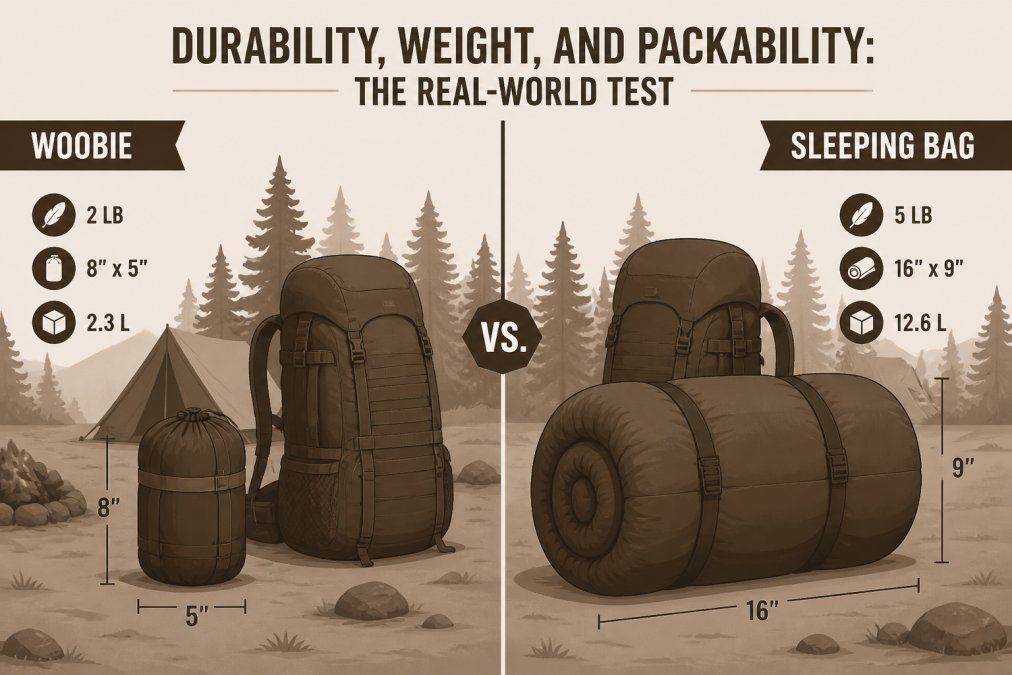
Packability is the woobie's strongest feature.
Care, Repair, and Lifespan
How you treat a woobie determines whether it lasts three seasons or ten. A few practices matter most:
- Washing. Machine wash cold on a gentle cycle with mild detergent, then tumble dry low or air dry. High heat degrades the synthetic batting and can melt the shell. Avoid fabric softener, which coats fibers and reduces loft.
- Storage. Store the woobie loose or loosely rolled, not compressed in a stuff sack for months. Long-term compression crushes the batting and permanently reduces warmth.
- Zipper care. Rinse the zipper after beach or desert camping to clear sand and grit, and apply zipper lubricant annually if you use it frequently. A stuck or broken zipper on a three-sided design compromises the entire system.
- Repair. Small tears in a ripstop shell can be patched with tenacious tape or a nylon repair patch. Fraying binding tape can be re-stitched or re-bound by a gear repair shop for a fraction of replacement cost. A broken zipper slider can often be replaced without replacing the whole woobie.
Field experience suggests woobies hold up well to rough handling: they don't tear easily, the stitching is strong, and the fabric resists snagging.
Is a Woobie Worth the Money? The Verdict
Whether is a woobie worth the money for camping depends on your camping style, your climate, and what you're comparing it to.
For backpackers: A woobie is worth the money.
For serious cold-weather camping: A woobie alone isn't sufficient.
For wet-weather camping: A wool blanket outperforms a woobie because it retains warmth when damp, and if you camp frequently in rain, that advantage justifies the extra weight and cost.
The Dragoon Unlimited woobies offer solid value.
The real answer: a woobie is worth the money if you'll actually use it as part of your camping system.
If you're building a backpacking kit or want versatile gear that handles multiple jobs, a woobie from Dragoon Unlimited is a solid investment. Start with a core model like the Trail Rider Olive Drab at $69.99, test it in your typical camping conditions, and decide if the weight savings and versatility justify keeping it in your kit.
Frequently Asked Questions
Are woobies actually warm enough for camping in cold weather?
Woobies provide solid insulation for mild to moderate cold conditions, typically effective for temperatures around 40-50°F when used alone. In colder weather, they work best as a sleeping bag liner or layered with other gear. For below-freezing temperatures, most campers use a woobie as part of a layered sleep system rather than standalone protection.
How does a woobie compare to a wool blanket for camping?
Woobies offer advantages in packability and weight, a woobie weighs around 1-2 pounds compared to 3-5 pounds for wool. Wool blankets retain warmth even when damp, though they take longer to dry. Woobies are crafted from water-resistant polyester. Wool costs more upfront; woobies cost $65-70. For backpacking, the woobie's lightweight design wins; for car camping comfort, wool may be preferred.
What makes a woobie worth the money compared to a sleeping bag?
A woobie at $65-70 costs roughly one-third the price of a quality sleeping bag ($150-300+). The trade-off is versatility over specialization: a woobie functions as a blanket, poncho liner, emergency shelter, or bivy cover, while a sleeping bag does one job well. Woobies excel as layering pieces and backup gear in bug-out bags. If you need a dedicated cold-weather sleep system, a sleeping bag outperforms a woobie. If you want multi-use gear for camping, hiking, and survival prep, the woobie's lower cost and flexibility justify the investment.
How long do woobies typically last with regular camping use?
Durability depends on care: rinsing off mud, air-drying fully before storage, and avoiding sharp branches extends lifespan significantly. Woobies can be machine-washed.
Whether you're preparing for your first camping trip or upgrading your sleep system, the choice between a woobie and other options comes down to your specific needs. Dragoon Unlimited's woobies are built for durability and real-world use, with three-sided zippers and weather-resistant materials that handle demanding conditions. Get one of our poncho liners and experience the versatility that has made woobies a favorite among veterans, backpackers, and outdoor enthusiasts for decades.


