


Table of Contents
- What Makes a Durable Survival Shelter
- Site Selection and Location Strategy for Long-Term Shelter
- Debris Hut Construction: The Foundation of Bushcraft Shelter Building Techniques
- Long-Term Survival Shelter Materials and Insulation
- Lean-To Shelter Variations and A-Frame Designs
- Emergency Preparedness Kits: Shelter Gear and Tools
- Maintenance and Repair Schedules for Long-Term Durability
- Tarp-Based Shelter Setups and Configurations
- Frequently Asked Questions
Last Updated: September 30, 2026
What Makes a Durable Survival Shelter
A durable survival shelter withstands extended exposure to harsh conditions while balancing portability, thermal regulation, and structural integrity.

A durable survival shelter requires proper insulation layers, waterproofing that holds up over weeks or months, and a framework strong enough to handle wind loads, snow accumulation, and ground moisture.
For extended wilderness deployment, hunting season, or emergency preparedness, your shelter needs durability as the primary design constraint.
Details matter: taped seams, ripstop fabric with UV resistance, non-compressing thermal insulation, and moisture-blocking ground beds distinguish shelters that last three weeks from those lasting three days.
Site Selection and Location Strategy for Long-Term Shelter
Site selection determines whether your structure will survive wind, shed water, and maintain thermal stability.
Identify terrain providing natural windbreaks: leeward ridge sides, dense tree lines, or rock outcrops. Avoid exposed ridgetops, open meadows, and areas downwind from cliffs where wind accelerates. Wind stresses seams, flexes frameworks, and collapses poorly positioned shelters.
Avoid low-lying areas where water pools. Choose slight elevation with ground that absorbs water. Position your shelter entrance away from prevailing wind and rain, typically south or southeast.
Balance proximity to firewood, water, and repair materials against visibility. A durable survival shelter hidden in brush or timber is more defensible.
Clear the site of sharp objects. Soft earth with moss or leaf litter provides cushioning; avoid rocky terrain and root systems that create uneven surfaces.
Debris Hut Construction: The Foundation of Bushcraft Shelter Building Techniques
A debris hut is the simplest durable survival shelter using natural materials. A ridgepole supported by two end frames creates an A-frame that sheds water and resists wind loads.
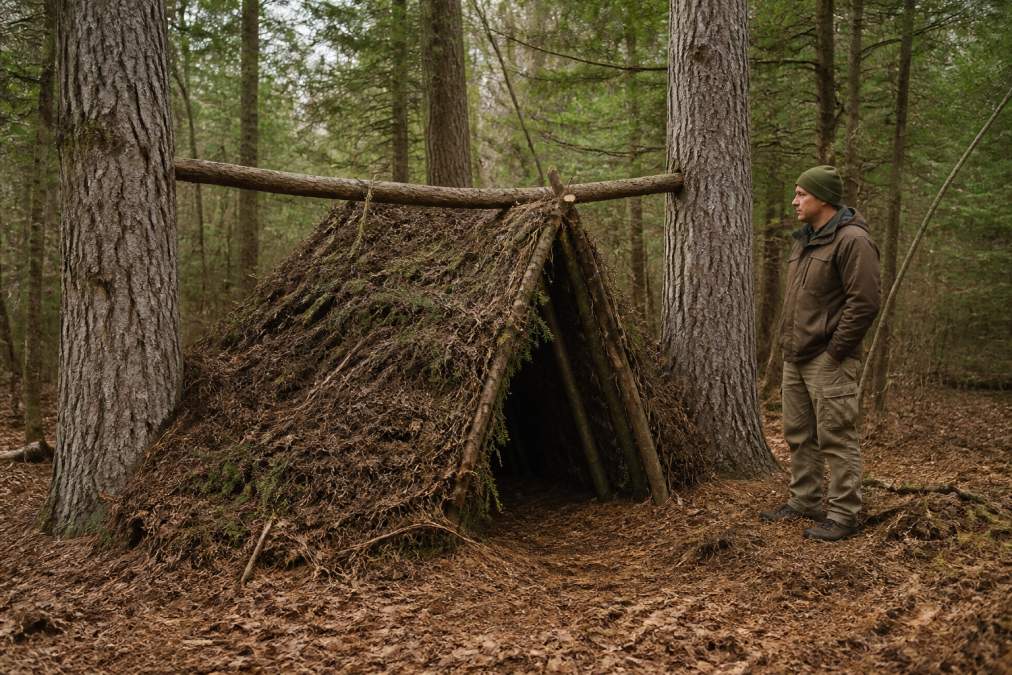
Select two trees or create sturdy end frames from lashed branches. Span a ridgepole at 4-5 feet height, lashing it securely with cordage or bark strips.
Lean branches against the ridgepole at 60-70 degrees, spaced 6-12 inches apart. This steep angle forces water to run off; smaller branches fill gaps.
Layer leaves, bark, pine boughs, and soil 12-18 inches deep to create insulation that traps air and maintains livable temperatures below freezing.
Build a small entrance facing away from wind to reduce heat loss. Create a ground bed using leaves or boughs to keep you off cold, damp earth.
Pros:
- Uses only natural materials
- Provides excellent thermal insulation
- Requires minimal tools or cordage
- Can be built in under 3 hours with practice
Cons:
- Time-intensive to gather sufficient debris
- Difficult to maintain in wet conditions
- Limited interior space for gear storage
- Requires suitable trees or frame materials nearby
Long-Term Survival Shelter Materials and Insulation
Material selection determines durability. Manufactured materials offer superior weather resistance compared to natural alternatives.
Ripstop fabric with UV protection resists tearing and maintains integrity after punctures. Taped seams prevent water wicking through stitching holes.
Ground bed insulation (3-4 inches of closed-cell foam, leaves, or pine boughs) prevents conductive heat loss, the primary way your body loses warmth.
Wall insulation traps dead air space to resist convective heat loss. In cold climates, 12-18 inches of debris provides meaningful thermal regulation.
For long-term survival, durability matters more than portability since you're building semi-permanent structures.
Ground Bedding and Thermal Regulation
A proper ground bed creates insulation between you and cold earth while managing moisture.
Dragoon Unlimited Ridgeback One Person →
Build a raised platform to stay above pooling water. Layer insulation (closed-cell foam, pine boughs, leaves, or bark chips) in 2-3 inch layers; multiple thin layers trap more air than one thick layer.
Balance insulation with ventilation to prevent condensation. Proper ventilation removes moisture while maintaining warmth.
Create small vents near the top on opposite sides to encourage cross-ventilation without ground-level drafts.
Waterproofing and Windproofing Techniques
Waterproofing is non-negotiable. Leaks compromise insulation, promote mold, and create hypothermia risk.
Pitch tarps at 45-50 degrees to shed water. Ensure all seams are taped or sealed and check regularly for holes.
Layer debris huts with bark or large leaves as base, then progressively smaller debris in a shingled effect.
Lean-To Shelter Variations and A-Frame Designs
A lean-to shelter is a single-slope structure that provides protection while maintaining visibility and airflow. It's simpler than an A-frame but less thermally efficient.
Lean-To Pros:
- Fast to construct
- Requires minimal materials
- Allows fire proximity and heat reflection
- Good visibility and airflow
Lean-To Cons:
- Limited thermal insulation
- Less protection from wind
- Vulnerable to side-wind rain
- Not suitable for extreme cold
A-Frame Pros:
- Excellent thermal regulation
- Superior wind protection
- Efficient water shedding
- Suitable for extended occupation
A-Frame Cons:
- More construction time required
- Requires more materials
- Limited interior space
- More difficult to maintain fire proximity
Emergency Preparedness Kits: Shelter Gear and Tools
An emergency preparedness kit designed for shelter construction should include tools and materials that enable rapid deployment of a durable survival shelter. The specific contents depend on your expected environment and duration of occupation.
Maintenance and Repair Schedules for Long-Term Durability
A durable survival shelter requires regular inspection and maintenance to remain functional. Establish a maintenance schedule based on your occupation duration and environmental conditions.
Tarp-Based Shelter Setups and Configurations
A tarp provides rapid weather protection and requires minimal construction skill. The challenge is configuring it for durability and thermal performance.
Frequently Asked Questions
What materials make a durable survival shelter the most durable?
The most durable survival shelters combine structural integrity with weather resistance. A solid ridgepole as the main frame, boughs or branches for the skeleton, and thick debris or natural insulation for the outer layer create durability. For long-term shelters, waterproof tarps or natural materials like bark layers add protection against rain and wind. Ground bedding elevated above soil prevents moisture damage. Materials should be locally available, which reduces weight and cost while improving structural fit to the environment.
How does a durable survival shelter prevent hypothermia?
A durable survival shelter prevents hypothermia through thermal insulation and windproofing. Insulation layers trap body heat by creating dead air space around your sleeping area. Proper ground bedding with boughs or leaves isolates you from cold ground contact. Windproofing seals gaps to prevent heat loss from drafts. A reflector wall behind a fire directs warmth into the shelter. The shelter's size should be small enough to retain body heat but large enough for safe ventilation, balancing warmth with air quality.
What are the differences between temporary and durable survival shelters?
Temporary shelters prioritize speed and minimal materials, designed for 72-hour survival situations. Durable shelters are built for long-term use, weeks or months, and require stronger structural integrity, better insulation, and maintenance schedules. Durable shelters use reinforced ridgepoles, grommets for secure attachment, and layered waterproofing. Temporary shelters may use simple lean-tos or emergency tarps. Long-term shelters need elevated platforms, proper drainage, and repair systems. The Ridgeback tent from Dragoon Unlimited bridges both needs with field-tested durability and rapid deployment.
Where can I legally practice bushcraft and shelter building?
Bushcraft practice is legal on private land with owner permission and on most public lands under specific rules. National Forests allow dispersed camping on designated areas; check your local Forest Service office for guidelines. State parks have designated camping zones. Public BLM lands in the West allow camping on undeveloped areas. Always verify local regulations before building permanent structures or fires. Respect Leave No Trace principles by removing shelters after use. Never build on protected archaeological sites or in restricted wilderness areas. Contact your regional land management agency for specific shelter-building permissions.
How do you maintain a long-term survival shelter in the wilderness?
Maintenance schedules for long-term shelters include weekly inspections of structural integrity, checking for loose ridgepoles or damaged boughs. Repair waterproofing after heavy rain by reapplying natural sealants or repositioning tarps. Clear debris from the roof monthly to prevent weight accumulation. Check ground bedding for moisture and replace damp insulation layers. Inspect grommets and cordage for wear, replacing frayed sections. Ensure drainage channels around the shelter remain clear. In high-wind environments, reinforce the A-frame or lean-to structure quarterly. These maintenance steps extend shelter lifespan from weeks to months.
What is the most effective shelter for survival in extreme weather?
For extreme weather, a debris hut or well-insulated A-frame offers the best protection. The debris hut's compact size retains heat in cold conditions while the thick debris layer provides insulation and windproofing. For heavy rain, a lean-to with a steep roof angle and elevated ground bedding prevents water pooling. In high winds, low-profile designs with reinforced ridgepoles outperform tall structures. Tarp-based shelters with proper grommets and guy-line tension handle variable conditions. The Dragoon Unlimited Ridgeback tent combines thermal regulation with weather-resistant ripstop fabric and taped seams, offering mission-ready protection in harsh environments.
What is the warmest survival shelter design?
The warmest survival shelter is a small, well-insulated debris hut with a reflector wall. The compact interior retains body heat, while thick debris layers provide thermal insulation. A reflector wall behind a fire concentrates warmth into the shelter, significantly raising interior temperature. Ground bedding with boughs or leaves prevents heat loss through the floor. The shelter entrance should be small and positioned away from prevailing winds. Insulation layers of leaves, bark, or pine needles create dead air space. For portable warmth, poncho liners like Dragoon Unlimited's Trooper MultiCam model provide additional insulation and can be layered with other gear.
What are some good long-term survival shelters for extended wilderness stays?
Good long-term shelters include elevated A-frame structures with reinforced ridgepoles, debris huts with maintenance access, and tarp configurations with proper drainage. Elevated platforms prevent ground moisture and pest intrusion. A-frames distribute weight evenly and resist wind better than lean-tos. Tarp shelters with grommets and secure cordage allow adjustments for seasonal changes. The Ridgeback tent from Dragoon Unlimited offers a field-tested alternative with 90-inch length, taped seams, and UV-resistant ripstop fabric designed for extended deployments. Combine any shelter with quality insulation layers and ground bedding for comfort during long stays.


