


Last Updated: November 12, 2026
Quick Summary
Emergency preparedness for apartment living means building a compact kit that fits a closet or entryway and a written plan you can walk in the dark. Store one gallon of water per person per day for at least three days, keep a seven-day supply of prescriptions, and take the stairs, never the elevator, during a fire.
- Build one stay-home bin plus one grab-and-go bag per person, sized for a closet or entryway.
- Push your water supply to seven days if you have the closet space.
- Count the doors between your unit and the stairwell in both directions for zero-visibility navigation.
- Text your out-of-area contact instead of calling, because texts get through when voice networks jam.
- Check and rotate your supplies every six months, in spring and fall when you change clocks.
Table of Contents
- Why Apartment Emergency Planning Is Different
- Your Apartment Emergency Kit Checklist
- Emergency Supplies for Small Apartments: Storage That Works
- Building an Apartment Evacuation Plan
- An Emergency Communication Plan for Apartment Residents
- Power Outages, Fires, and Shelter-in-Place
- Planning for Pets, Kids, Older Adults, and Neighbors
- Building Your Apartment Emergency Kit This Weekend
- Frequently Asked Questions
Why Apartment Emergency Planning Is Different
Emergency preparedness for apartment living starts with one hard fact: you don't control the building. You control what's inside your four walls and how fast you can get out of them.
Three things make apartment planning its own discipline. You share walls, so a neighbor's kitchen fire becomes your evacuation. Most units have one exit route, so a blocked stairwell changes everything. And storage is measured in cubic feet, so every item earns its shelf space.
Here's how to build a kit, a plan, and a supply rotation that fit a rental and work when the power dies at 2 a.m.
Your Apartment Emergency Kit Checklist
An apartment emergency kit is a compact, self-contained set of supplies that lets you shelter in place or evacuate within minutes, sized to fit a closet or entryway. Build it in one bin plus one grab-and-go bag. The bin stays home. The bag leaves with you.
What Goes in the Kit
- Flashlight plus spare batteries, one per household member
- Battery or hand-crank radio for local alerts
- First-aid kit with bandages, gauze, tape, antiseptic, and a splinter kit
- Seven days of prescription medications in labeled bags
- Phone charger bank, charged monthly
A common mistake is treating a first-aid kit and an IFAK as the same thing. An IFAK handles trauma; your apartment kit handles scrapes, burns, and a week of headaches. Our guide on IFAK versus first aid kit covers the difference.
Water, Food, and Medication
Store one gallon of drinking water per person per day for a minimum three-day supply, and push to seven days if you have the closet space. That's the standard guidance from Ready.gov's emergency supply guidance, and it's the number to build around.
Food should be non-perishable and no-cook: canned goods with pull tabs, peanut butter, crackers, protein bars, and instant coffee. Add a manual can opener.
Medications are the item people forget. Keep a seven-day supply of every prescription in your kit, plus a written list of dosages and prescriber names.
Here are the core supply numbers to build your kit around.
| Item | Value | Note |
|---|---|---|
| Drinking water | One gallon per person per day | Minimum three-day supply; push to seven days if space allows |
| Prescription medications | Seven-day supply | Keep in labeled bags, plus a written dosage list |
| Flashlights | One per household member | Plus spare batteries |
| Phone charger bank | Charged monthly | Keep in the kit |
| Food | Non-perishable and no-cook | Canned goods with pull tabs, peanut butter, crackers, protein bars |
| Manual can opener | One | Add to the food bin |
| Documents | Copies of ID, lease, and insurance | Keep in a zip bag |
| Cash | Small bills | Keep in the kit |
Emergency Supplies for Small Apartments: Storage That Works
Storage is where apartment prepping usually dies. The fix is vertical, labeled, and zoned. Pick one closet shelf, one under-bed bin, and one entryway hook, then assign each a job. The goal isn't a bunker.
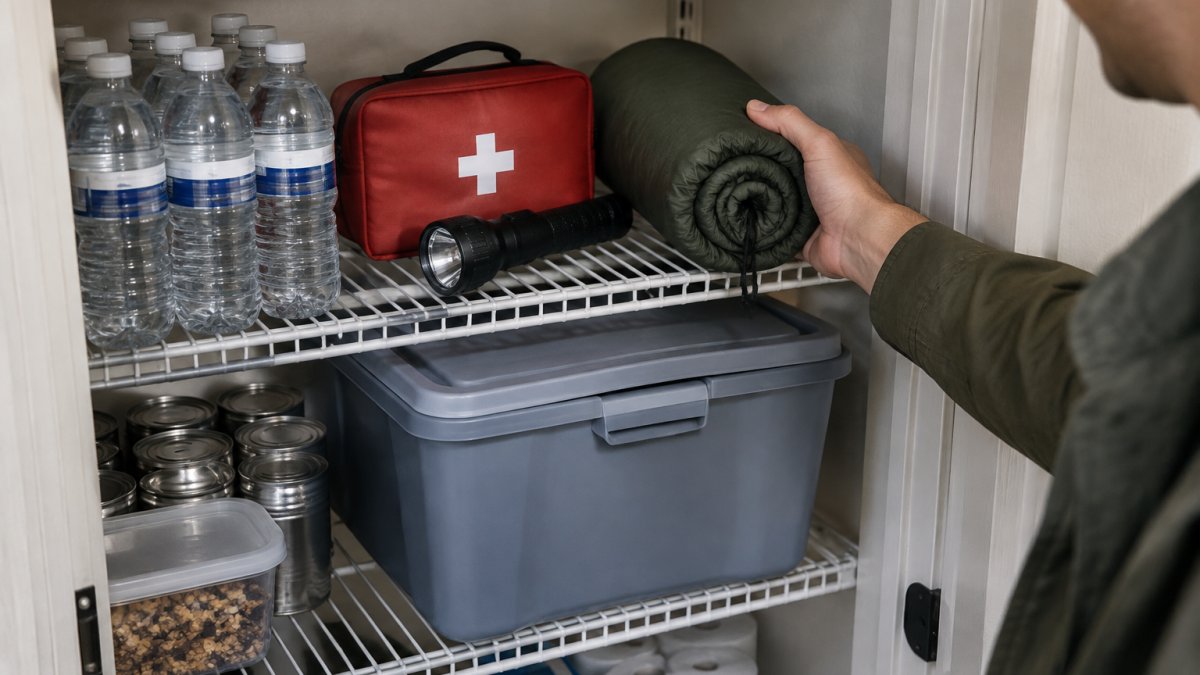
Three Zones, Three Jobs
The grab zone. By the door: one bag per person, a flashlight, a multi-tool, and a paper copy of your contact card.
The stay zone. Under the bed or on the closet floor: water, no-cook food, medications, batteries, and the first-aid kit.
Use a vertical shoe rack on the closet door for flashlights, batteries, and masks. Use a hanging organizer for gloves and small tools.
Water and Food in Tight Quarters
Water is the space hog. One gallon per person per day for three days is the floor; seven days is better if you have the closet.
Food should be non-perishable and no-cook: canned goods with pull tabs, peanut butter, crackers, protein bars, and instant coffee. Add a manual can opener. Keep the food in one bin so you can see what you have.
Rotating Supplies Without a Basement
Rotation is a calendar problem, not a space problem. Write the purchase month on every item with a marker.
A simple rule: buy what you eat, eat what you store, and never let a bin become a museum.
Medications and batteries don't belong in a hot closet or a bathroom cabinet.
For pantry depth, our guide on building a prepared pantry walks through stocking and rotation in tight spaces.
Building an Apartment Evacuation Plan
An apartment evacuation plan is a written route from your door to a safe meeting point, with a backup route, a head count, and a decision rule for when to stay put.
Start with your primary exit route: door, stairwell, lobby, outside. Then walk your backup: the second stairwell, the fire escape if your building has one, or a window onto a lower roof.
Part of the plan is knowing your shut-offs. Our article on where the water shut-off valve is explains how to locate it and who to call.
High-Rise Exits, Stairs, and Elevators
In a fire, take the stairs. Never the elevator.
Count the doors between your unit and the stairwell, both directions. In zero visibility, that count is your navigation.
Keep a flashlight and closed-toe shoes by the bed. Glass and debris in a dark stairwell are the real hazard, not the flames.
If smoke is in the stairwell and you can't get out, stay in your unit.
When Exits Are Blocked or You Can't Take Stairs
Not everyone can take thirteen flights. If stairs are a problem for you or someone in your unit, name a helper and a backup now, not during the alarm.
If both exits are blocked, your unit becomes the shelter. Close doors between you and the smoke. Stuff the gap under the door. Call and stay on the line.
Watch out: a fire escape that's been painted shut, blocked by a window air conditioner, or used for storage is not an exit.
The Meeting Point and the Head Count
Pick a meeting point that's outside the building and out of the fire lane: a tree, a sign, a corner across the street.
Do a head count at the meeting point. Then text your out-of-area contact. If someone is missing, tell a firefighter at the command post; don't go back in.
Walk the whole plan once a season. Time it. Fix what's slow. A plan you've never walked is a wish, not a plan.
An Emergency Communication Plan for Apartment Residents
An emergency communication plan for apartment residents is a single card listing an out-of-area contact, a meeting point, and each household member's phone number.
Pick one out-of-area contact everyone checks in with. Local lines clog; long-distance often doesn't. Add your building's management office number and a neighbor's number to the card.
The FCC's emergency communications guidance recommends keeping a backup charging method and knowing your local alert system.
Power Outages, Fires, and Shelter-in-Place
A power outage in an apartment is a heat, light, and food problem at once. You lose the fridge, the heat, and the elevator in one hit.
- Keep the fridge closed. It holds cold for hours if you don't open it.
- Use flashlights, never candles. Open flame in a shared building is how fires start.
- Layer up. A poncho liner or warm blanket beats a space heater you can't plug in.
- Check on elderly neighbors on your floor.
For a small-space backup power setup, our guide on basic backup power covers what actually fits an apartment and what doesn't.
Fires get their own rule. Feel the door before you open it. If it's hot, use your second exit.
Planning for Pets, Kids, Older Adults, and Neighbors
The people and animals in your unit change the plan. Build a go-bag for each: kids carry a small pack with a flashlight and a comfort item.
Older adults and anyone with a disability need a named helper and a backup.
Coordination is the angle most guides skip. Introduce yourself to your floor. Swap numbers. Agree on who checks on whom.
Building Your Apartment Emergency Kit This Weekend
You can have a working kit, a written plan, and a rotation card done in one weekend. Here's the order:
- Saturday morning: Buy water, no-cook food, batteries, and a flashlight per person.
- Saturday afternoon: Assemble the bin and the grab bag. Label everything.
- Saturday evening: Draw your two exit routes and time them.
- Sunday morning: Fill out the communication card and sign up for local alerts.
- Sunday afternoon: Tape the rotation card inside the bin lid and set a reminder for six months out.
One piece of gear we'd add without hesitation is a poncho liner. Our zippered poncho liners can serve as a blanket, sleeping bag liner, or serape on a cold night. If you want the full 72-hour checklist to compare against your own list, our emergency preparedness kits guide has it.
The challenge is simple: most people plan to get ready and never do. Pick this weekend, build the bin, and sleep better.
Dragoon Unlimited builds gear for our friends, and that includes the ones in a third-floor walk-up. Start with a poncho liner for warmth when the power fails, add the Ridgeback bivy tent if your plan includes sheltering outside, and get your kit squared away before the next storm.
Frequently Asked Questions
How do you prepare for emergencies when you live in an apartment?
Start with three things: a compact apartment emergency kit, a written exit plan, and a communication plan. Store at least a three-day supply of drinking water at one gallon per person per day, plus non-perishable food, a flashlight, batteries, a first-aid kit, and your medications. Walk your exit route and count the doors to the stairwell so you can find it in smoke. Then coordinate with your household and neighbors so everyone knows where to meet.
What should be in an apartment emergency kit?
A workable apartment emergency kit fits in one bin or duffel: three days of water and non-perishable food, a flashlight and spare batteries, a first-aid kit, a week of medications, a battery or hand-crank radio, phone chargers and a power bank, copies of documents, cash in small bills, and a weather-resistant layer. Add a compact blanket or poncho liner for warmth if the heat goes out. Keep the kit near your exit, not buried in a closet.
How much emergency water should an apartment household store?
Plan on one gallon per person per day for at least three days, so a two-person apartment needs roughly six gallons. Store it in food-grade containers in a cool, dark spot, and rotate it every six months. If space is tight, stack rectangular jugs on a closet floor or under the bed. Keep a few bottles in your go-bag too, so you have water if you have to leave fast.
How can you store emergency supplies in a small apartment?
Use vertical space and furniture that doubles as storage. Under-bed bins hold water and food, closet shelves take labeled totes, and a sturdy shoe rack can hold a kit by the door. Pick one shelf per category so you can see what you have. Rotate food and water by keeping the oldest in front and replacing it as you use it. A compact kit beats a perfect one you never built.
What should an apartment evacuation plan include?
An apartment evacuation plan should name two exit routes from your unit, the stairwells you will use, and a meeting spot outside the building. Count doors and stair flights so you can move in low light or smoke. Note that elevators are out during a fire, so plan on stairs. Assign someone to grab the kit and someone to handle pets. Practice the route twice a year and check that exits are not blocked.


