


Last Updated: November 24, 2026
Quick Summary
Choose a camouflage camping tent by matching the pattern to your actual terrain first, then sizing it to your body plus gear. Rhodesian Brushstroke suits dry brush and tall grass, M81 Woodland suits dense eastern forests, and Tiger Stripe suits jungle and riverbottom thickets. Camo pays off most in a one-person bivy, not a family dome.
- A big family dome in camo is a novelty; a one-person bivy in camo is a tool.
- Tent capacity ratings lie by one person, so size for people plus gear.
- Camo fabric adds no warmth in cold weather; your insulation does the work.
- Ask for the hydrostatic head number in millimeters, not the marketing adjective.
- Campsite placement in a shadow line conceals better than any fabric pattern.
Table of Contents
- Start With the Pattern, Not the Price Tag
- Camping Tent Types and Which One Camo Fits
- Tent Size and Capacity for Solo, Pair, or Group
- The Best Color for a Camping Tent Depends on Where You Sleep
- Cold-Weather Tent Camping in a Camouflage Shelter
- Weather Specs, Fabric, and Setup: What Actually Decides It
- Pitch It Right: Campsite Placement and Field Care
- Build Your Own Camouflage Camping Tent Setup
- Frequently Asked Questions
Start With the Pattern, Not the Price Tag
Most people pick a camouflage camping tent by price, then wonder why it looks like a dark blob sitting in a field. Pattern comes first. Terrain decides pattern, and pattern decides whether the shelter disappears or announces itself.
At Dragoon Unlimited, we build shelters around that idea. A pattern that works in Georgia pines is wrong for Kansas wheat stubble.
Match the pattern to the ground you actually hunt or camp on:
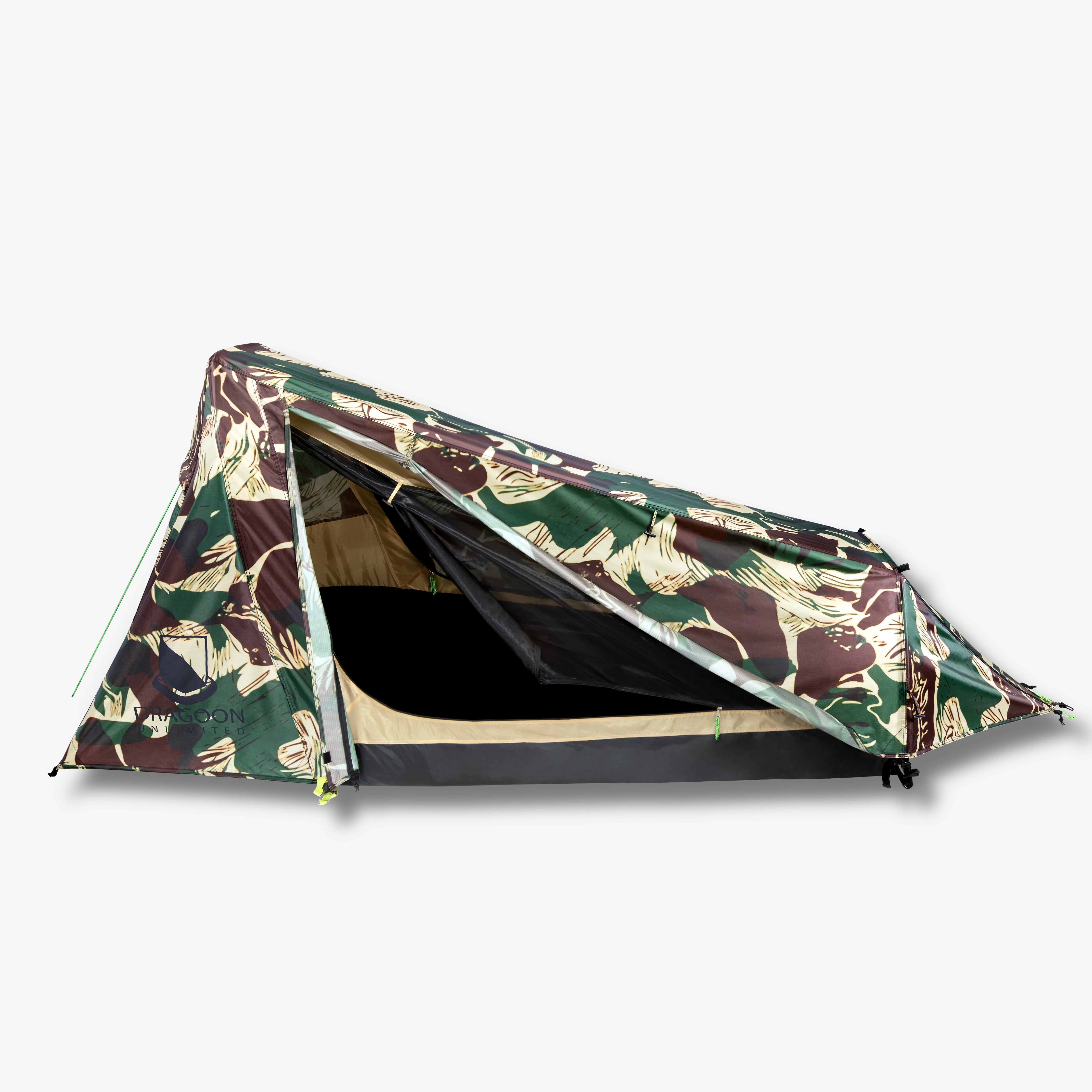
- Rhodesian Brushstroke: broken vertical shapes for dry brush, tall grass, and mixed timber edges.
- M81 Woodland: heavy green and brown blocks for dense eastern forests and shaded creek bottoms.
- Tiger Stripe: sharp stripes for jungle, riverbottom thickets, and tall reed grass.
- MultiCam-style patterns: blended tones for open ground and varied light.
- Solid green: low profile in timber, and far less conspicuous than a bright dome.
If you want to see how a real Rhodesian Brushstroke shelter reads against timber before you commit, the Ridgeback bivy in Rhodesian Brushstroke shows the pattern on an actual pitched shelter.
One honest note: camo hides the tent, not the campsite. A perfect pattern beside a white cooler and a blue tarp fools nobody.
Camping Tent Types and Which One Camo Fits
Camping tent types split into four working categories, and camo matters most in the smallest ones. A big family dome in camo is a novelty. A one-person bivy in camo is a tool.
Here is how the categories break down:
| Tent Type | Capacity | Best Use | Camo Worth It? |
|---|---|---|---|
| Bivy / one-person | 1 | Backpacking, hunt camp, bug-out | Yes, highest value |
| Two-person backpacking | 2 | Pair trips, light base camps | Yes, moderate value |
| Three-season dome | 2-4 | Car camping, weekend base camp | Marginal |
| Four-season / hot tent | 2-4 | Cold weather, stove use | Marginal |
Capacity
The bivy is where camouflage pays off. You carry it deep, you pitch it low, and you want it to vanish. Family domes sit in developed campgrounds where nobody is glassing the treeline.
If you want to browse the full shelter lineup and see which type matches your trip, the tents and shelter collection lays out the options side by side.
Tent Size and Capacity for Solo, Pair, or Group
Tent capacity ratings lie by one person, always. A "two-person" tent fits two people who don't mind touching shoulders and have nowhere to put their packs.
Size the tent to people plus gear, not people alone:
- Solo: look for real length. Most one-person tents are cut short. A 90-inch floor lets a tall camper stretch out and still keep a pack inside.
- Pair: a two-person tent works for two adults only if you accept gear in the vestibule or under your feet.
- Group: three or more means a dome or cabin tent, and camo stops mattering.
Interior space is the number that decides comfort. Headroom, shoulder width, and floor length beat a capacity sticker every time. A pack, a rifle, and a pair of wet layers eat space fast.
For a solo shelter that fits a full-size adult plus gear, the Ridgeback runs 90 inches long with 40 to 42 inches of headroom and 40 inches at the shoulders.
The Best Color for a Camping Tent Depends on Where You Sleep
The best color for a camping tent is the one that matches your ground and your light. There is no universal winner, and anyone selling you one is selling you a story.
Work it out in three questions:
- What is under the tent? Green grass and timber favor green and woodland patterns. Dry grass and sage favor tan and brushstroke.
- How much light hits it? A dark tent in open sun reads as a shadow. A light tent in shade reads as a smear. Match the value, not just the hue.
- Who is looking? Wildlife notices outline and movement more than color. A low, tight pitch beats a fancy pattern every time.
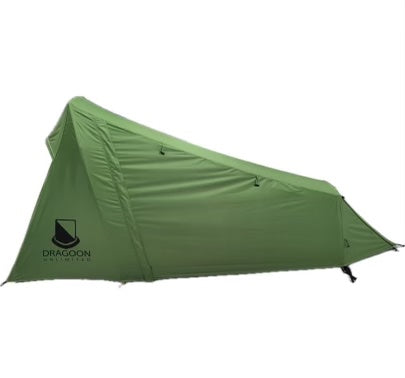
Solid colors have one real advantage: they are predictable. A deep green shelter disappears in timber and never looks out of place. If you want to compare a solid green option against camo for your local ground, the Ridgeback bivy in Emerald Green gives you that side-by-side without guesswork.
Bright colors exist for a reason, and that reason is safety. If you camp where you might need to be found, visible is smarter than hidden.
Cold-Weather Tent Camping in a Camouflage Shelter
Cold-weather tent camping turns a shelter into a sleep system, and the tent is only one part of it. Camo fabric does not add warmth. Your insulation does.
Three things decide whether you sleep or shiver:
- Block the wind. A tight pitch with a low profile sheds wind better than a tall dome.
- Manage condensation. Your breath freezes on the walls. Ventilation matters more in cold than in rain.
- Insulate from the ground. A sleeping pad does more for warmth than any tent wall.
A camouflage shelter pairs naturally with a poncho liner as a sleep layer. A woobie packs small, dries fast, and layers over a bag when the temperature drops past the rating. Our guide to why a woobie works for cold-weather camping walks through how to layer it without cooking yourself at 2 a.m.
Watch out: sealing every vent to stay warm is the fastest way to wake up in a frozen, soaked bag. Leave the vents open and trust your insulation.
Weather Specs, Fabric, and Setup: What Actually Decides It
Weather specs decide whether a tent is a shelter or a wet bag, and the label rarely tells the whole story. Ignore marketing words. Read the construction, then read the numbers.
Here is how to compare two shelters side by side without getting fooled:
- Hydrostatic head. This is the water pressure a fabric holds before it leaks, measured in millimeters. Ask for the number, not the adjective.
- Seam treatment. Taped or factory-sealed seams are the difference between dry and damp. Untaped seams need field sealing before the first trip, and that is a chore you do once and then trust.
- Floor construction. A bathtub floor curls up several inches at the edges so ground water pools outside instead of wicking in. A flat floor with a low seam is a wet sleeping bag waiting to happen.
- Wind resistance. Low profile plus a solid stake count beats a tall dome every time. Look for reinforced stake points and a fly that reaches near the ground. A shelter rated for high wind but pitched with four stakes is a kite.
- Ventilation. Condensation management is a spec, not a vibe. Look for high and low vents, a mesh inner, and a fly that can be pitched open at the door. A sealed shelter turns your breath into interior rain by morning.
- Setup style. Color-coded webbing and a two-pole pitch go up fast in low light, which is when bad weather usually arrives. Practice the pitch once in daylight before you trust it at dusk.
Fabric matters too, and it is where camouflage and solid colors diverge. Ripstop resists tears either way. If you camp in open sun, a lighter solid color runs cooler; if you camp in timber, a dark pattern hides better and the heat trade-off rarely matters. A dark pattern’s usefulness depends on matching the timber around it, and Better Grab A Beer can help you think through how hunting camouflage choices relate to the terrain.
The Ridgeback carries UV-resistant ripstop, taped seams, a bathtub floor, and color-coded webbing on two aluminum poles. It packs to 5 by 18 inches at 4 pounds 9 ounces. Compare those numbers against any shelter you are considering.
Pitch It Right: Campsite Placement and Field Care
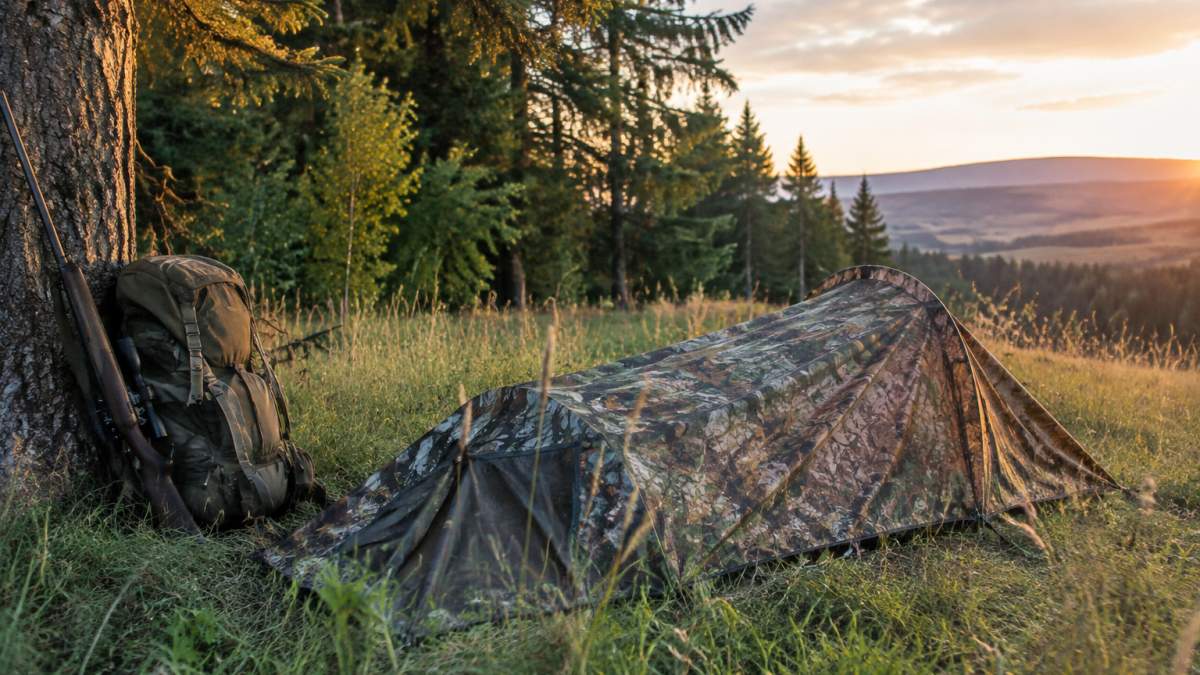
Campsite placement does more for concealment than any fabric pattern. A camo tent pitched on a bare ridge in full sun is a billboard.
Placement rules we follow:
- Use the shadow line. Pitch where the tent sits in the shade of trees or a bank.
- Break the outline. Set up beside brush or a fallen log, not in the open.
- Stay off game trails and water edges. You are a guest in that space, and a tent on a trail is both conspicuous and rude to other users.
- Check the rules first. Check the managing agency's rules for your area before you go, and follow them.
Concealment is not just the pattern. Distance, light, and silhouette do most of the work.
There is a time to be visible. Hunting seasons and orange-clothing requirements vary by state and species. Check your state wildlife agency's rules for the season and unit you are in.
Field care keeps a shelter working. Dry the tent fully before storage, wipe the floor, and store it loose rather than crammed tight.
Watch out: pitching under a lone tall tree feels clever until the first storm. Look up before you stake down.
Build Your Own Camouflage Camping Tent Setup
Building your own setup means pairing the shelter with the layers around it, and the shelter is the anchor. Get the tent right and the rest follows.
A practical build order:
- Shelter. Pick the pattern for your terrain and the size for your body plus gear.
- Sleep layer. A pad for ground insulation and a poncho liner or bag for top insulation.
- Cover. A tarp or poncho overhead adds a dry zone and a second layer of concealment.
- Kit. Keep it small enough to carry, organized enough to find in the dark.
If you are assembling a shelter from scratch, field-tested tarp and poncho configurations round out the kit. Our DIY poncho tarp shelter setup guide covers pole setups, knots, and configurations that work with a bivy.
Then test it. Pitch the whole setup in the yard on a cold, windy night before you trust it in the field. A shelter you have not slept in is a guess.
The hardest part of choosing a camouflage camping tent is not the pattern or the price. It is being honest about where you actually sleep and what you actually carry.
Dragoon Unlimited builds shelters for that decision. The Ridgeback bivy comes in Rhodesian Brushstroke and Emerald Green, with UV-resistant ripstop, taped seams, a bathtub floor, and color-coded webbing for fast setup in bad light.
Get started with Dragoon Unlimited and pitch a shelter that fits your ground, your season, and your load.
Frequently Asked Questions
What is the best color for a tent when camping?
It depends on the job. For stealth camping, hunt camp, or a bug-out setup, a camouflage camping tent or a low-key earth tone keeps you from standing out. For general car camping in busy campgrounds, a brighter color makes your site easier to spot and can be easier to find in low light. Match the color to your environment and your reason for being out there.
Does a camouflage tent actually work for camping?
Yes, as long as you pick the pattern for your terrain. A camo tent breaks up its outline the same way a hunting shirt does, which helps at hunt camp and in a stealth camping setup. It does nothing if you pitch it on a bright gravel pad in the open. Pattern plus placement is what makes it work.
What size tent should I choose for a solo camping trip?
Go bigger than one person. A one-person tent sized for a real adult, like the Ridgeback at 90 inches long with 40 to 42 inches of headroom, gives you room for a sleeping pad and your gear without sleeping curled up. If you plan to bring a pack, a rifle, or a stove inside, that extra length and shoulder room matters more than the weight savings.
How cold is too cold to sleep in a tent?
The tent is rarely the limit; your sleep system is. Your sleeping pad and bag matter more than the tent. Choose insulation rated below the overnight low you expect. Test your gear on a cold night at home before you trust it in the field.


